Every gated process in a company is a queue wearing a diligence costume. This is
the story of un-gating one: how we rebuilt third-party app submission on Square's
developer platform as a self-serve product — paved path, automated validation,
review workflow, operational tooling — and typical partner launch time fell from
around 90 days to around 20. I made the bet, funded the team, and set the product
direction; the design was led by
Alex Jacque,
Square's head of design for the platform.
RoleHead of Product, Developers & Partners
When2022 · 6 months to first ship
Team1 PM · 1 designer · 6 eng · PMM · content
StatusShipped — live in Square's Developer Console today
What this demonstrates
Seeing the bottleneck others had normalized. A 90-day launch queue had been accepted as the cost of quality. I funded the bet that it was a product problem, and set the target customer deliberately wide: any developer, no partnerships meeting required.
Building the unglamorous whole. Self-serve isn't a form — it's documentation, validation, review workflow, compliance gates, comms, and admin tooling. We shipped all of it, with a small senior team, in six months.
A concrete, checkable outcome. Typical partner launch time fell from ~90 days to ~20 — the team's own numbers, told publicly by the project's design lead in his own portfolio — and the product is live in Square's Developer Console today.
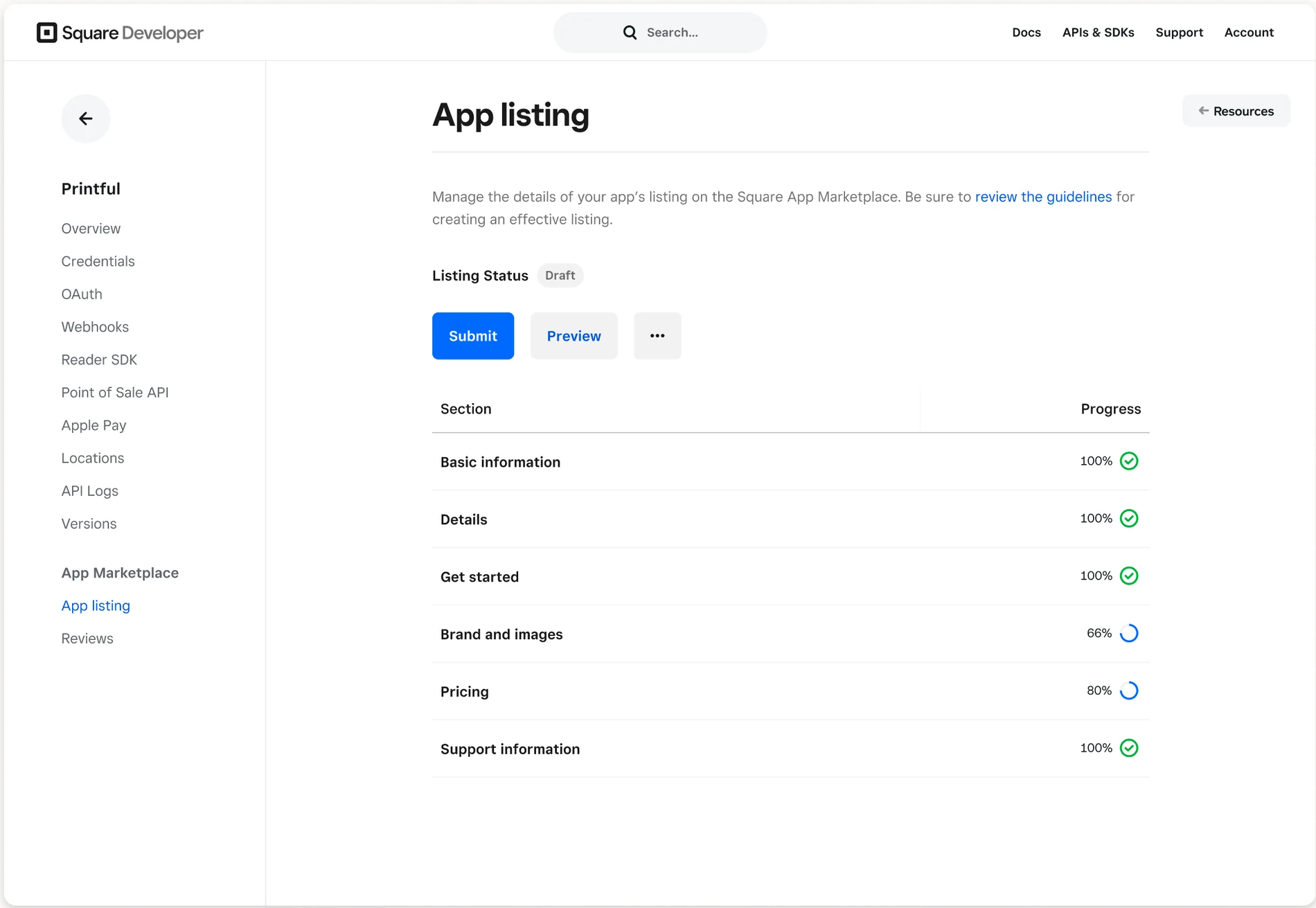
The shipped App listing editor in Square's Developer Console: a listing decomposed into sections with completion states, and a Submit button where a partnerships meeting used to be. Design led by Alex Jacque.
01
A bottleneck disguised as diligence
In 2022, getting a third-party app listed on Square's App Marketplace took a
typical partner about 90 days. Not because anyone was lazy — because
the process was artisanal. Partners filled out a sprawling multi-tab spreadsheet of
listing content; internal teams chased errors and omissions by email; every
submission was a bespoke conversation between the developer, partnerships,
marketing, and content specialists. There was no validation, no single source of
truth, and no way for a partner to know where they stood.
The dangerous part of a process like this is that it looks like rigor. Every manual
step had a reason. But the platform's growth loop — more developers building apps,
more apps in the marketplace, more sellers running on partner software — was being
throttled at its narrowest point, and the narrowest point was us.
“Y'all, we can do better.”
Alex Jacque, head of design for the platform — from his own public telling of this project. He was right.
The decision I owned was to treat the queue as a product problem and fund a real
team against it: one PM, one product designer, an engineering manager and five
engineers, a product marketer, and a content specialist. Six months. And one scope
decision that shaped everything downstream — the target customer wasn't our
existing managed partners. It was any developer, including the ones
who would never get a partnerships meeting. If the system only worked with a human
escort, it wasn't the system I wanted.
02
Why almost nobody builds this
Here's the context that makes this project interesting beyond Square. True
self-serve third-party onboarding — build, submit, and launch without talking to a
human — is rare in B2B software, and vanishingly rare in payments. The dominant
pattern in the industry is a “become a partner” form that routes to a
business-development queue. That's not because companies don't want self-serve;
it's because a self-serve gate is an enormous amount of product. You are signing up
to build public documentation, machine-enforceable requirements, automated and
human review, legal agreements that work at click-through, security and compliance
checks, transactional comms, and the internal tooling to operate all of it — where
a partnerships funnel needs only a form and a calendar.
The scale of that machinery is easiest to see at Apple, which runs the world's
reference implementation: in 2025 its App Review operation evaluated
over 9.1 million submissions and rejected over 2 million of them,
per Apple's own transparency report — hundreds of expert reviewers working behind
what developers experience as a simple submit button. In Square's own
space, the pattern at the time we built — and largely still today — was gated:
Toast's integration program runs through a partnership application,
business-development vetting, a signed partner agreement, and staged certification
before an app is listed; Clover requires identity-verified production developer
accounts and multi-stage functional, legal, and listing review; and Lightspeed's
marketplace starts with a partner application to its partnerships team. Even
Shopify — the strongest self-serve developer experience in commerce, and one we
studied openly — gates every launch behind its app review team. Outside commerce,
Salesforce's AppExchange security review alone is quoted at four to eight weeks.
None of that is a criticism — those companies are being responsible with their
merchants' data and their platform's trust, and so were we. It's a statement of
the problem's difficulty: in a payments platform, an app gate is a
compliance-and-security product, not a form. Which is exactly why building it
self-serve was worth funding, and why we benchmarked against the consumer app
stores — Google Play Console, App Store Connect, Shopify Partners — rather than
against other payment companies' partner programs.
The system: how you make a gated process self-serve
The transferable framework, before the Square specifics. Making a gated process
self-serve means replacing each human checkpoint with a system that does the same
job better:
A paved path instead of a conversation. The submission becomes a structured product surface — every requirement visible, every section tracked, progress explicit — so the applicant always knows what's left.
Validation instead of correction. Requirements are enforced at input time, not discovered by a reviewer three weeks later.
A review workflow instead of an inbox. Human judgment stays — for content quality, technical QA, and compliance — but it runs on a status pipeline with explicit states, diffs against previous submissions, and structured feedback the applicant can act on.
Compliance as product, not meetings. Legal agreements move to click-through; security and technical requirements become a checklist mirrored in public docs, so developers self-assess before they ever submit.
Comms and monitoring as first-class scope. Every state change notifies the developer automatically, and internal tooling gives the operating team a queue they can actually run.
On Square, that framework became a status pipeline every submission moved through —
and both sides of it got real product. The developer-facing half lives in the
Developer Console; the internal half was an admin console where reviewers worked a
submissions queue, saw per-section diffs against the previous version, ran
technical QA gates, and tracked availability across Square's countries. (The
internal tooling isn't pictured here; it's someone else's operational surface now.)
The submission pipeline. Every state visible to the developer, every transition automated — human judgment kept where it earns its place.
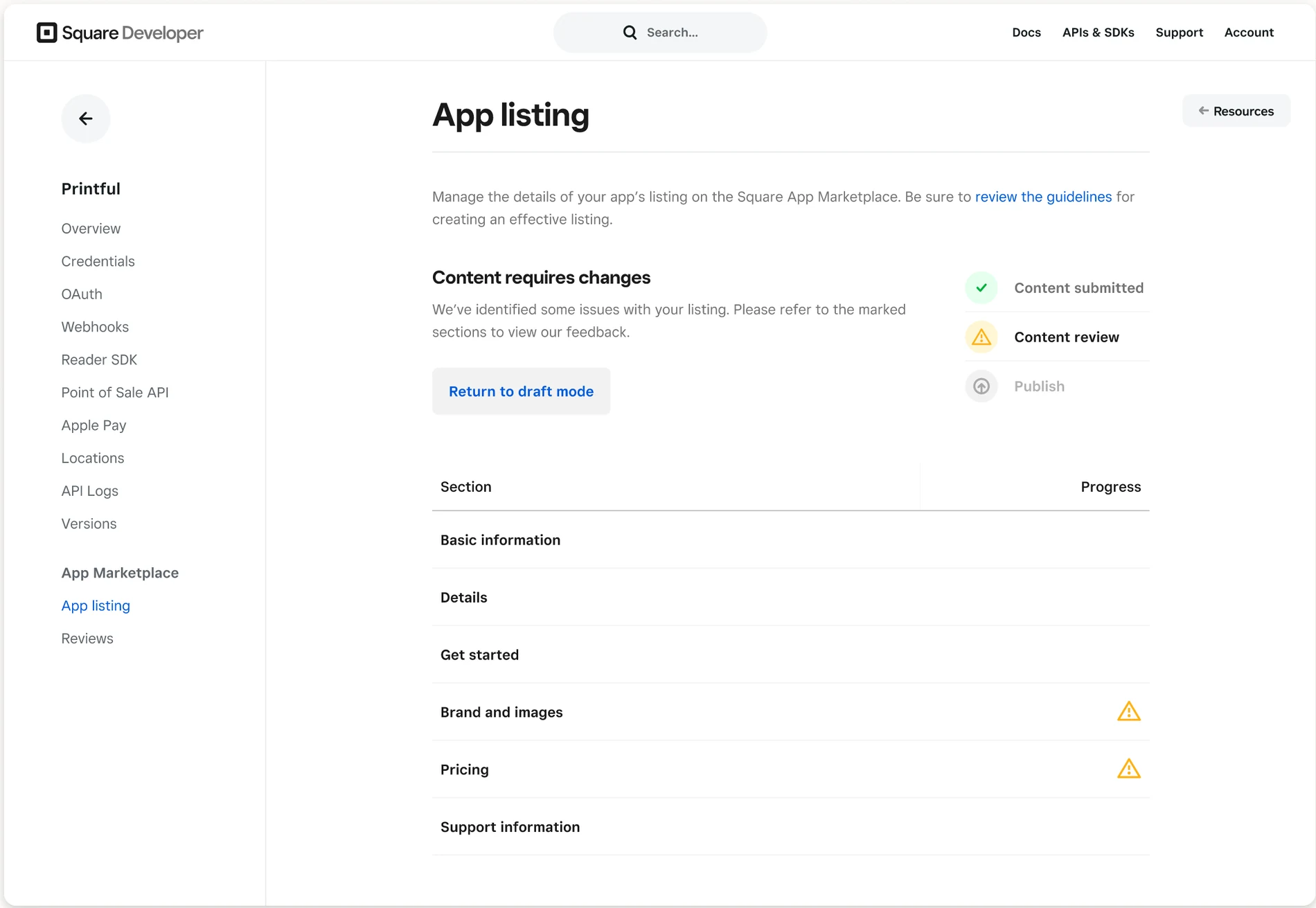
When review found problems, the developer didn't get a phone call — they got a
flagged listing with per-section feedback and a path back to draft mode:
The feedback loop, shipped: content submitted ✓, content review flagged, per-section warnings, and a “Return to draft mode” action. Design led by Alex Jacque.
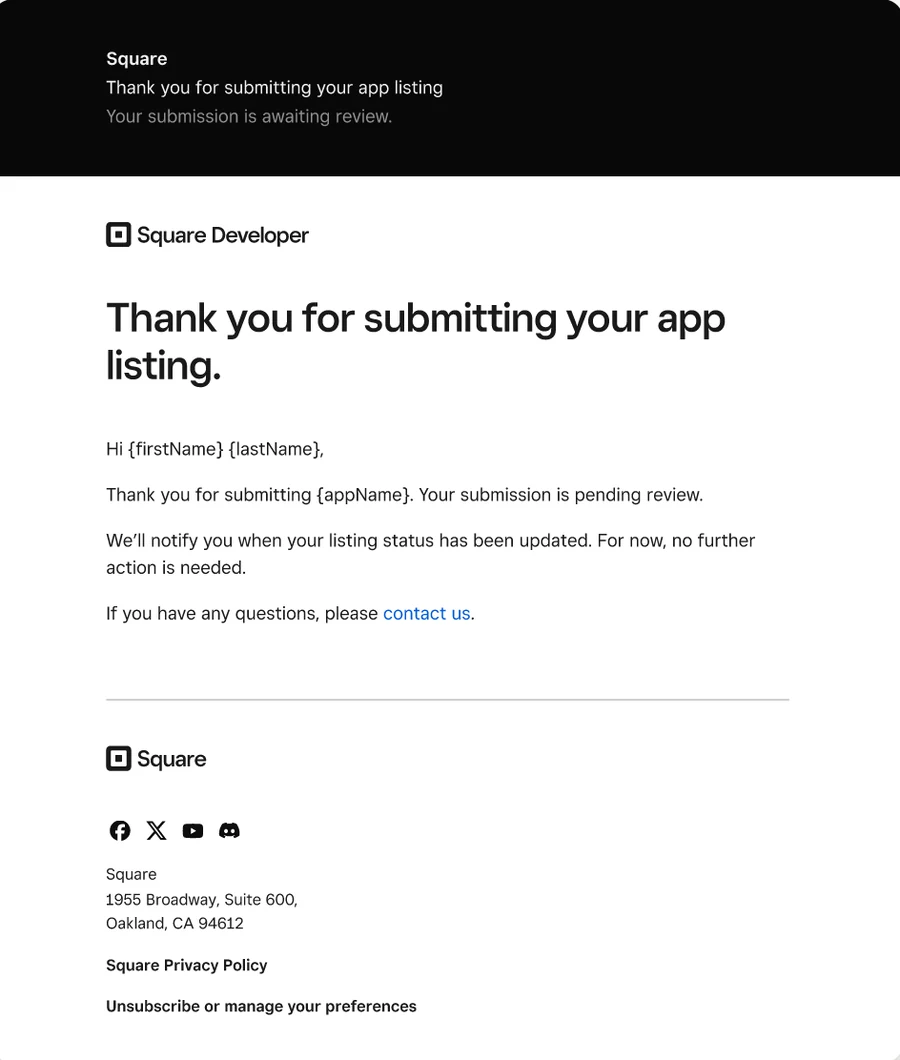
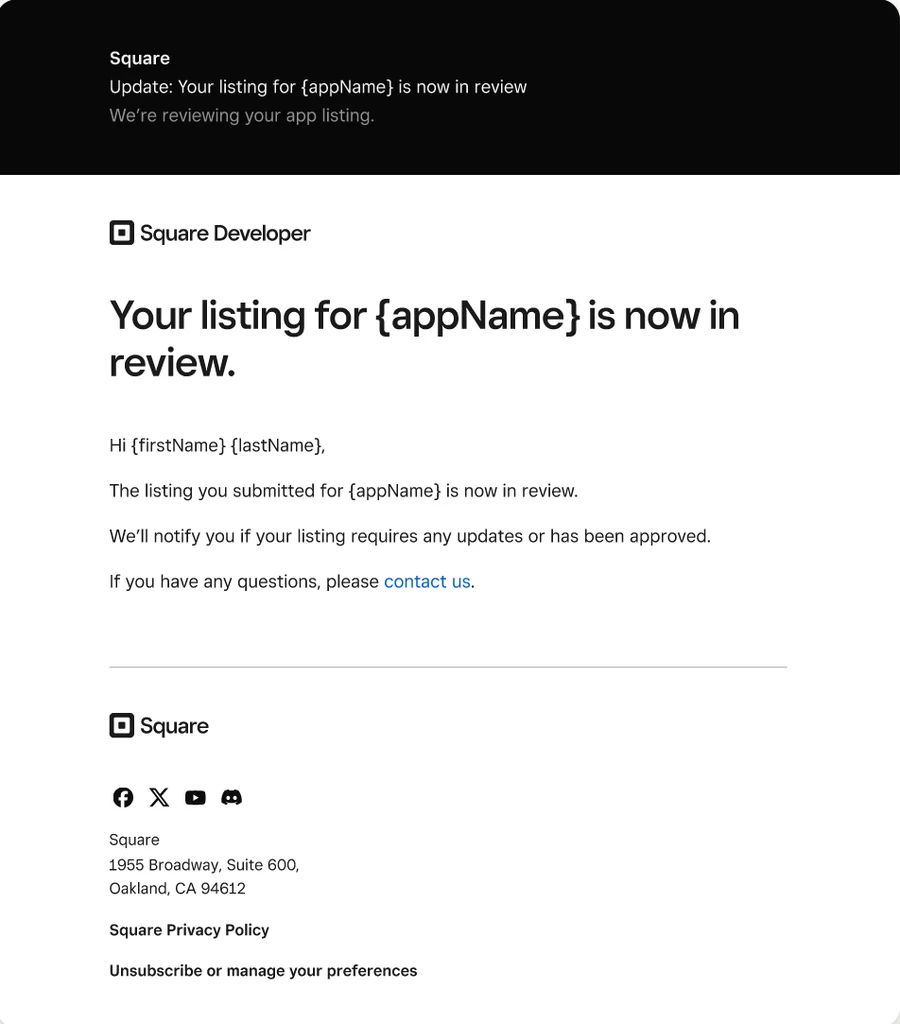
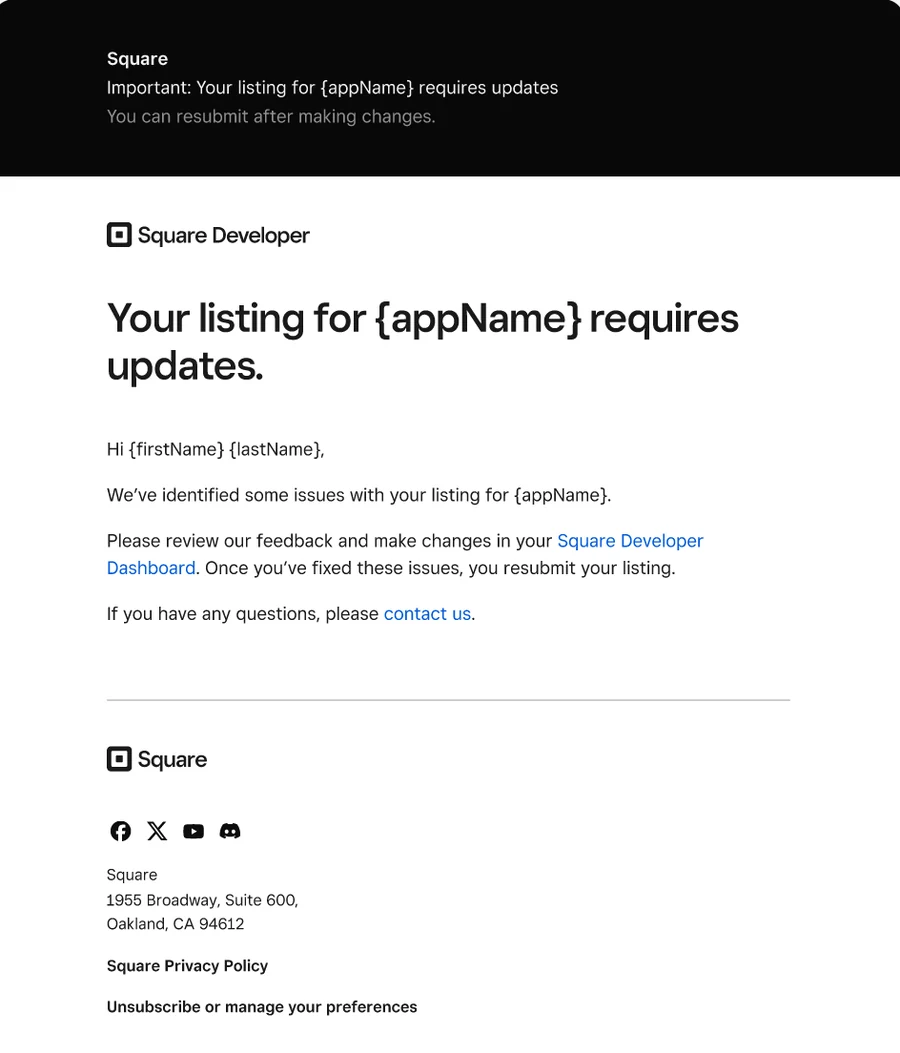
And the machine talked back. Every state change carried a transactional email —
submitted, in review, requires updates — so no developer ever had to ask
“what's happening with my listing?”:
SubmittedIn reviewRequires updates
The last mile was content: we made the submission requirements public in Square's
developer docs, so a developer could see exactly what an effective listing required
before writing a word. Requirements you publish are requirements you've been forced
to make coherent — externalizing the checklist improved the checklist.
04
The result
~90 daysTypical partner launch time, before
~20 daysTypical partner launch time, after
4.5×Increase in partner launch speed
An honest label on these numbers: they're the team's own operational measurements,
not a Block financial disclosure — and they're public because the project's design
lead tells the same 90-to-20 story in his own portfolio. What I can add from the
product side is what the speed bought: with the queue gone,
new-app launches grew by multiples, and the platform team's
partnerships and content specialists stopped being a routing layer and went back to
doing judgment work. The system story — how this fit the platform's operating
model — is in The operating model is the product.
05
The endgame: no humans in the doorway
The 2022 ship was the beginning, not the end. Over the following two years the team
kept pulling humans out of the doorway: the technical QA process moved into the
tool itself — walkthrough-video submission, a QA checklist mirrored one-for-one in
the public docs — and, the step I cared about most, a
click-through agreement that let any developer submit an app to Square
without talking to partnerships first. That closed the loop on the
original scope decision: the door didn't just open faster for invited guests; it
opened for everyone.
That's also the claim you can check. Square's partner page today says any developer
can build and launch an app in the App Marketplace, and the developer forums
announced the fully self-serve submission experience publicly in 2024. The
infrastructure outlived my tenure — which is the whole point of infrastructure.
One more thing these rails carried: when we built
Add-ons a year later — third-party functionality
rendered natively inside Square's own surfaces — its distribution path was this
same submission system, extended with an add-ons section. Bet #1's infrastructure
became bet #2's launchpad. Platforms compound like that when the boring layer is
built right.
06
What I'd do differently
Ship in-context guidance with v1. Deeper content guidelines inside the editor — examples and standards at the point of writing — were struck from the first release for scope. Right call under the timeline, but it left quality correction to the review loop, which is the expensive place to do it.
Design for localization from the first schema. Square operates in multiple countries and currencies, and the listing model should have accepted developer-provided translations from day one. Retrofitting internationalization into a content pipeline costs more than building it in — a lesson I'd apply to any platform surface now.
Publish the operational metrics as we went. The 90-to-20 result lived in internal dashboards for years before it had a public telling. Build the public proof alongside the work — filings, docs, keynotes — so the record can speak at full resolution when you need it.