What if a third-party developer could extend Square's own surfaces — natively,
safely — instead of rebuilding 90% of a product to deliver 10% of new value? That
question became Dashboard Add-ons: a program I conceived, advocated for, and funded
as Head of Product, designed by a team led by
Alex Jacque,
and proved in alpha with external partners. It was paused in 2024 when the company
redirected platform resources — and the industry has since built the thesis anyway.
Both halves of that story are worth telling straight.
RoleHead of Product, Developers & Partners
When2023 – 2024 · vision to alpha in about a year
Team1 PM · 1 designer · 6 eng · UX research
OutcomeProved in alpha with external partners; paused 2024
What this demonstrates
Original platform strategy, argued from first principles. The resource curve says no company can build every feature its customers need; the 90/10 argument says extensibility is the only move that scales. I made that case, won the funding, and set the bar: native Square UX, not iframes.
Evidence before conviction, architecture before scale. Seller research validated demand before the build; a two-year engineering estimate became two months when we bet on a sandboxed Remote DOM architecture instead of embedding.
An honest ending, owned. Add-ons reached alpha with real external partners and was paused in a 2024 resource shift — after I'd advocated for it and believed in it. The extensibility thesis has since gone industry-standard. I'd make the same bet again, earlier.
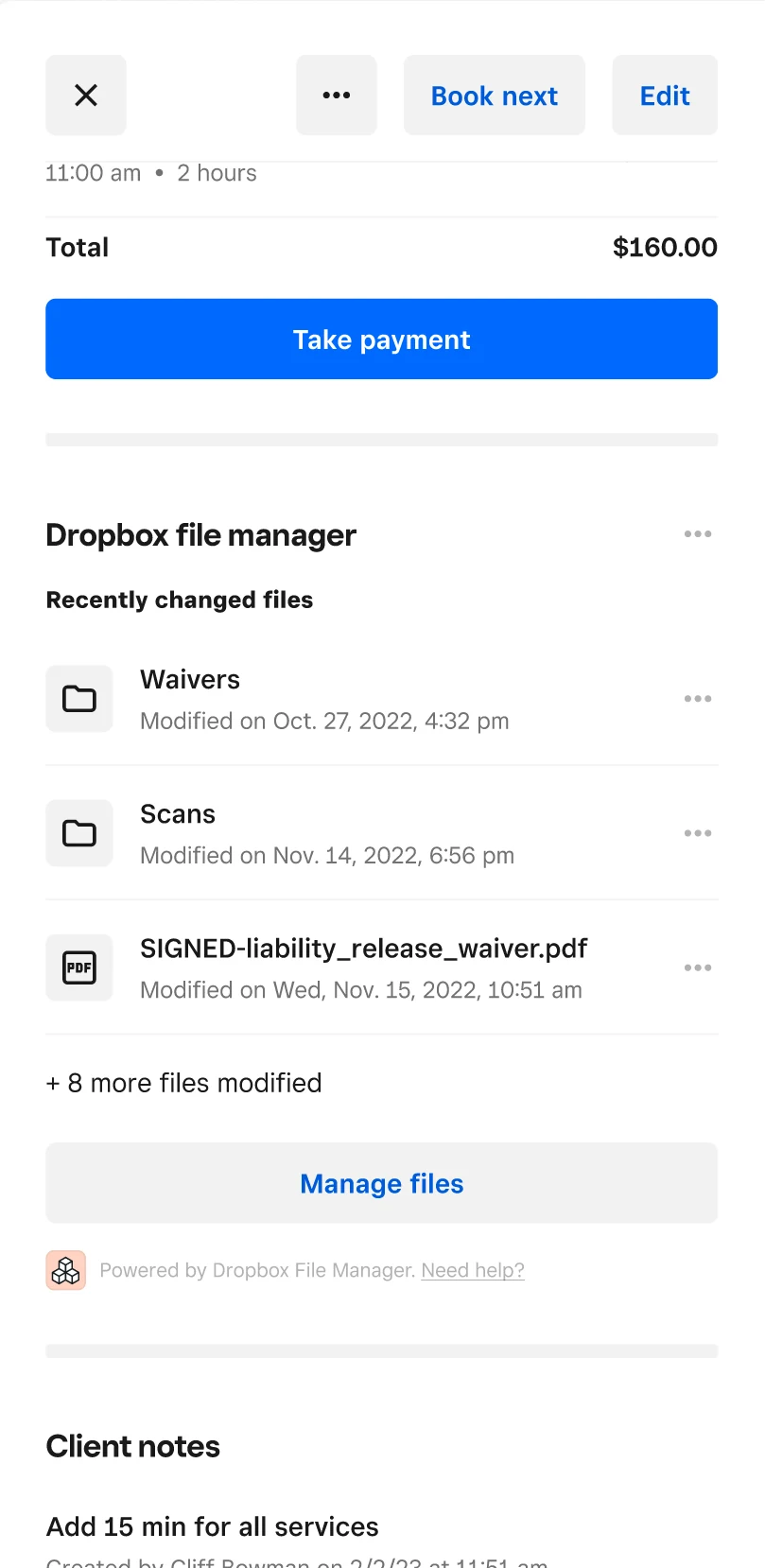
The idea in one screen: a Dropbox file-manager add-on living natively inside a Square Appointments panel — third-party functionality, first-party experience. Alpha-era UI, designed by Alex Jacque's team.
01
The hub illusion
Every platform company draws the same diagram: its own logo in the middle, its
products radiating outward, the customer's business orbiting the center. It's a
comforting picture and it is not the reality. A real seller runs their business
across a constellation of tools — accounting software, e-commerce platforms,
marketing suites, help desks, booking systems — and Square is one node in it. As
Square moved upmarket, that constellation got denser: bigger sellers have more
specialized needs, and more of their operations live in software Square doesn't
make.
The strategic question I kept putting in front of the organization: if the goal is
to be the command center of a seller's business, you cannot get there by building
every spoke yourself. The math forbids it.
The resource curve I argued the program from: first-party engineering covers the head of seller needs; the long tail is only addressable through third parties. Redrawn from the frames Alex Jacque and I used internally.
The sharpest version of the argument fits in one question: what if we could
give third-party developers a way to extend our first-party offerings without
having to build 90% of similar features just to have that 10% of new niche
functionality? A booking product with document management. An orders
dashboard that knows about your shipping provider. Today a developer who wants to
add that 10% must rebuild the other 90% — their own app, their own auth, their own
UI — and the seller pays for it in tab-switching and re-entered data. Let them
build only the differentiated slice, rendered inside Square's own surfaces, and
everyone's economics change: the developer's cost collapses, the seller's workflow
unifies, and Square's platform becomes more valuable with every add-on it hosts.
That was the bet. I wrote it up, argued it, and spent four months building
organizational support before a line of product code — the funding motion was
itself a project. We validated demand along the way: the team's UX researcher
surveyed sellers at scale, and the interest was overwhelming — most respondents
already ran multiple third-party tools alongside Square, and they wanted them in
one place. (The survey internals are Block's, so they stay internal; the program
was funded on that evidence.)
02
Principles before pixels
Extensibility programs die two ways: they're so open they degrade the host product,
or so constrained nobody builds on them. We wrote the guardrails first:
Meet sellers where they are. Add-ons appear inside the workflows sellers already run — the appointment panel, the order detail, the dashboard home — not in a separate app they must remember to open.
The seller manages a business, not a toolbox. Enabling, permissioning, and paying for an add-on had to feel like Square, end to end.
Shorten time-to-value — for the developer too. Industry-standard tooling, a paved path to build, and distribution through rails that already existed.
Keep the remarkability bar high. Third-party did not get to mean second-rate. Add-ons rendered with Square's own design-system components, so a Dropbox or DocuSign panel was visually indistinguishable from Square's own UI.
That last principle had teeth. It ruled out the cheap answer — and set up the
defining engineering fight of the program.
03
Native, not embedded: the architecture fight
The fast way to put third-party UI inside your product is an iframe. It's also the
way to get a product that feels like a mall kiosk: foreign styling, broken resize
behavior, UI that can't escape its box, and a security posture you're forever
litigating. Product and engineering leaned toward iframes because the alternative
looked unaffordable — the initial estimate for a native rendering approach was
two years. Alex, whose design bar the whole program rested on,
refused to accept the iframe experience, and pushed hard for a better answer. My
job was to hold the funding steady while the disagreement resolved on evidence
instead of fatigue.
The answer came fast once the right expertise joined: a front-end specialist built
a proof of concept in two weeks on Remote DOM — the open-source
approach Shopify published for exactly this problem — and the two-year estimate
collapsed to about two months. Add-on code executes in a sandboxed
context with no direct access to the host page; it describes its UI, and a
serialized view tree crosses the boundary to be rendered by Square's own
components. Security stays tight, and the seller sees native Square UX.
Remote DOM in a nutshell: the add-on runs sandboxed, its view tree is serialized across the boundary, and Square's own components render it. Native UX, iframe-free — with iframe-grade isolation.
Two lessons I've carried since. First, when design and engineering disagree about
what's possible, the cheapest move a product leader can make is funding a
short, real spike — two weeks of proof beat months of meeting-room estimation.
Second, the pattern won on the merits industry-wide:
Remote DOM is public open source
and powers Shopify's extensibility surfaces today. We weren't clever in isolation;
we were early on a pattern the industry has since converged on.
04
What it looked like
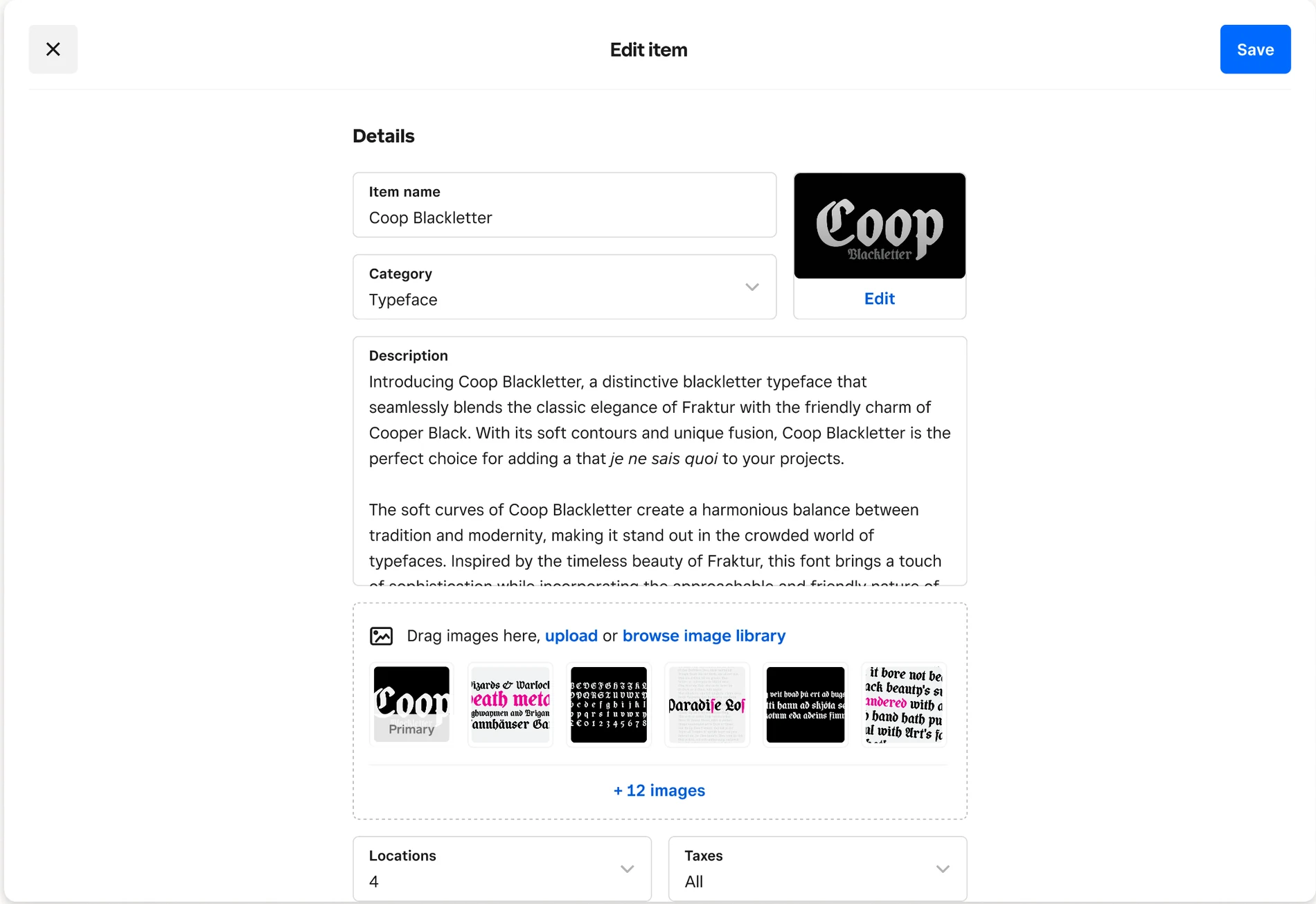
The screens tell the story faster than I can. A digital-goods seller edits an item
in Square, and SendOwl — one of our alpha partners — is simply there,
inside the item editor, managing delivery of the files the item sells:
Alpha-era UI: SendOwl's digital-delivery add-on inside Square's item editing surface. If you can't tell where Square ends and the partner begins — that was the bar. Design by Alex Jacque's team.
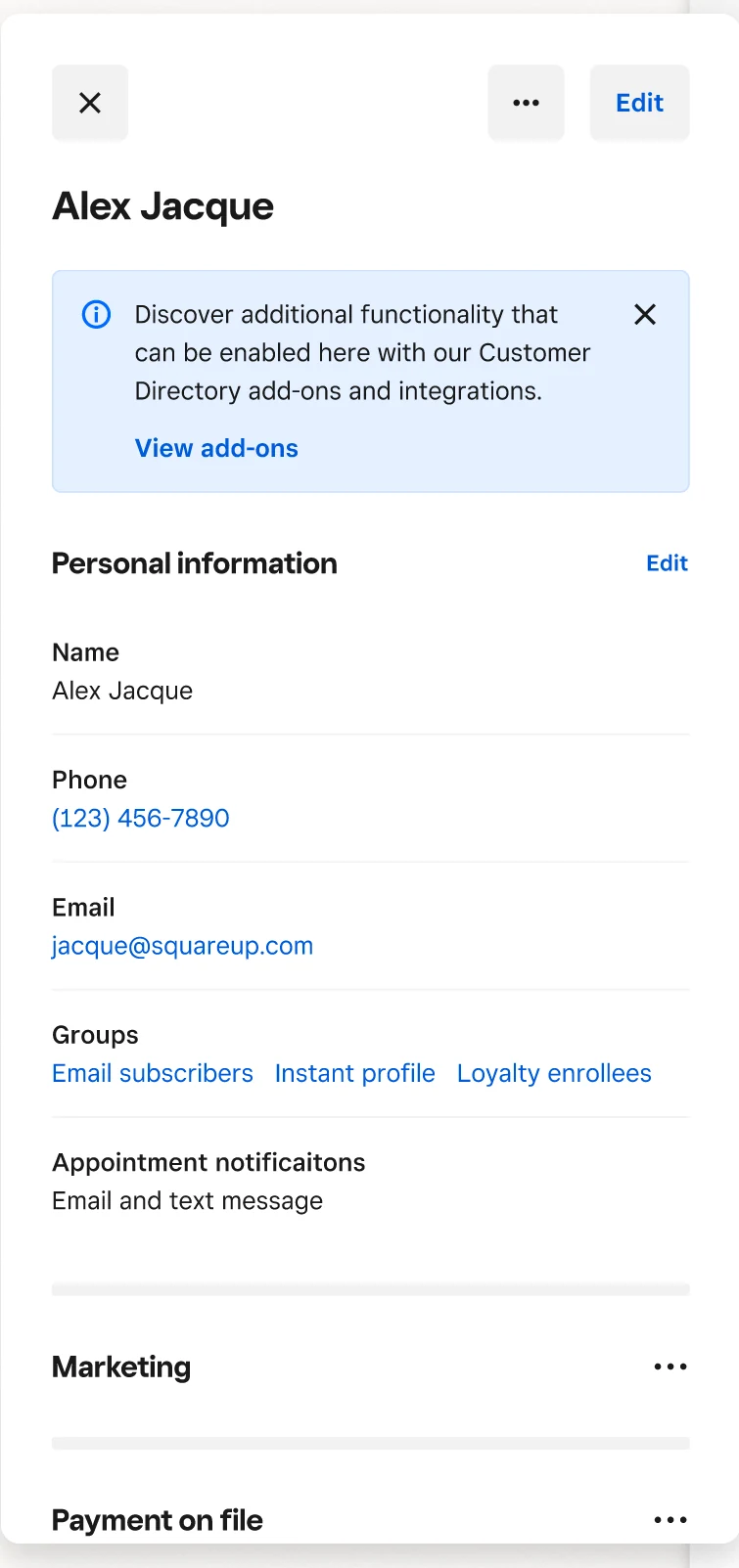
Discovery worked the same way — contextual, not catalog-first. Sellers found
add-ons where the need surfaced: a banner inside the customer directory, an
in-product prompt beside the workflow the add-on extends, backed by App
Marketplace search that could filter by which Square surface an add-on appears on:
In-context discovery: the add-on suggestion lives inside the seller's actual workflow. Alpha-era UI.
And because this was a payments company's dashboard, the unglamorous half got
built too: enablement flows that told a seller exactly which surfaces an add-on
would appear on; role-based permissions so a front-of-house
manager could see signed documents but not create shipping labels; loading and
failure states for when a partner's servers went down; and support routing that
sent sellers to the developer's support channels, not Square's call centers —
third-party functionality that failed like a professional product, not like a
widget.
05
Riding the self-serve rails
Distribution cost the program almost nothing — because the platform had already
paid for it. A year earlier we had rebuilt app submission as a
self-serve pipeline; Add-ons extended that same
listing flow with an add-ons section, so a developer packaged their add-on,
attached it to their marketplace listing, and only the content needed fresh
review. Developers built with industry-standard tools — Node.js, a templating
layer that mapped to Square's design-system components, locale files for
international surfaces — and submitted builds through a CLI that triggered
automated and manual QA and security checks, on a versioned release process.
This is the compounding I care about most in platform work: bet #1's
infrastructure became bet #2's distribution, unchanged. When the boring layers are
built as products, every later bet gets cheaper.
06
The alpha, and the honest ending
Add-ons ran a real external alpha: developer preview documentation, a local
development server, component design guidelines, a Figma toolkit, and working
add-ons from external partners — SendOwl's digital delivery and
appfoundation.io's appointment tooling among them, rendering natively inside
Square surfaces for real workflows. The thesis held: third-party developers could
ship native-feeling Square functionality without Square building it, and without
the seller ever leaving their dashboard.
Then 2024 reorganized the company's priorities, and the platform's frontend
resources moved to other bets. Add-ons was paused before general availability.
I won't dress that up: I conceived it, fought for its funding,
and believed in it — and the company made a portfolio decision that went the other
way. That's what a portfolio is. My honest scorecard: the demand evidence was
real, the architecture was right, the alpha proved the experience — and I'd
fought the program's cause harder and earlier in the annual planning cycles, where
resource contests are actually decided.
The epitaph matters less than the vindication. The extensibility thesis Add-ons
bet on is now the industry's default direction — Shopify's Remote DOM powers
production extensibility at scale, and every platform racing to be legible to AI
agents is rediscovering the same truth: the platforms that win are the
ones third parties can extend without permission meetings. Add-ons are
dead; long live add-ons. I wrote about where that thesis goes next in
Don't ship the org chart, and
about the decade-long platform arc it belongs to in
How a platform becomes structural.
07
What I'd do differently
Secure multi-year funding commitments for platform bets. Add-ons was funded annually, which meant re-arguing an infrastructure thesis against feature roadmaps every planning cycle. Platform extensibility pays back on a longer clock than a fiscal year, and the funding structure should match the payback curve.
Get paying partners into the alpha. Our alpha proved the experience worked; it didn't prove anyone would pay for it. A revenue signal — even a small one — is the strongest armor a program has when resources get contested.
Publish the pattern earlier. Shopify open-sourced Remote DOM and owns the narrative for an approach we were building in parallel. Platforms should publish their architecture bets — it compounds credibility with exactly the developers you're courting, and it makes the work legible outside the building. This page is me applying that lesson late.