← All Square work
Square · decision memo
Running the platform.
In 2022, Square's executive team selected me to lead product for the Developers & Partners business — the platform I'd spent six years building, now a ~200-person organization with a distinct P&L. This memo is about what running it actually took: one ML bet made against the room's instincts, and one rewrite of how the platform shipped at all.
What this demonstrates
- Conviction against consensus, run on evidence. When the org wanted marketplace polish, I took churn interviews and funnel data into the room, proposed ML-driven recommendations instead, and proved it with a three-week POC.
- Operating-model change as a product decision. The platform's biggest blocker wasn't a feature — it was how delivery was structured. I rewrote it, and products stuck in alpha for years shipped.
- An executive who stayed coachable. The strategy critique that stung in 2020 is the reason leadership handed me the platform in 2022 — and I can tell that story in order.
The scope
Developers & Partners was the business behind everything in the founding memo: the public APIs and SDKs, REST and GraphQL; developer docs, portal, and funnel; auth, sandbox, rate limiting, webhooks; the developer dashboard and the app creation, review, and launch pipeline; the App Marketplace; developer monetization and payouts; the in-person and online payments SDKs; and the platform's ML products — operating in all eight Square countries. I led product across the ~200-person organization, with 16 direct reports spanning product managers and a platform-operations team.
The APIs I'd once written the specs for were now processing $17B+ a year in payment volume (GPV) directly. The job was no longer building the platform. It was making it compound — and noticing when the thing in the way was us.
The bet against the room
Our 2023 north star was aggressive: double the number of sellers attached to partner apps, year over year. The room's instinct — marketing and partnerships leaders included — was to polish the App Marketplace: better browsing, better listings, more merchandising. It's the intuitive answer. A marketplace is the thing you can see.
I didn't believe the funnel supported it, so I went to the evidence: churn interviews with sellers who had tried apps and abandoned them, and the funnel data end to end. What it showed was that discovery wasn't failing in the marketplace — it was failing before sellers ever got there. A seller wrestling with inventory doesn't browse a marketplace looking for an inventory app; they struggle inside their workflow and give up. The marketplace was a destination; the problem lived in the journey.
So I proposed something different: contextual, ML-driven app recommendations embedded in seller workflows — the right integration surfaced at the moment the seller's own behavior signaled the need. Overriding peers whose teams wanted the polish work was not free; I spent the credibility deliberately, and put a limit on it: a three-week proof of concept, hold-one-out evaluation, judged on conversion against the existing funnel. If the model lost, we'd polish the marketplace.
The model didn't lose. Conversion improved by multiples — not percentage points — and held as we scaled it into production surfaces. Within four months the peers who had pushed back hardest were advocates, their own roadmaps building on the recommendation engine. We didn't just hit the doubled north-star goal; we beat it. I featured the work in my Unboxed 2023 keynote, which is public and linked below.
The same evidence-first pattern ran through the quieter win of that era: moving app onboarding to self-serve. Every app had been white-glove — a bottleneck disguised as diligence. We rebuilt the journey so developers could build, submit, and launch without waiting on us, and new-app launches grew by multiples.
Rewriting the operating model
The platform had one structural disease, and it took standing at the top of it to see it whole. Public API delivery had been coupled to internal-platform convergence — the principle that Square's own products should be rebuilt on the same public APIs we shipped to developers. As philosophy, elegant. As an operating model, it meant every external launch waited on internal migrations it didn't need, and products sat in alpha for years while the convergence work crawled.
I wrote the case for decoupling them: ship public APIs on the public roadmap's clock, let internal convergence proceed on its own, and stop holding developers hostage to our own architecture ambitions. It was a direct challenge to years of orthodoxy, and I made it in writing, through the decision process the company actually used — I wrote 30+ SPADE decision documents in this era, ten of them reviewed at CEO level, and demoed launches directly to Jack Dorsey. The operating-model rewrite was adopted, and the logjam broke: products that had spent years in alpha finally shipped, and the platform's release cadence became something we could be proud of again.
The trade-off was real and I'd make it again: decoupling meant accepting that internal and external surfaces would diverge for a while, and that some convergence work would slip indefinitely. I traded architectural purity for shipped product, on the theory that a platform's credibility compounds with launches, not with internal elegance.
The feedback that made the job possible
The honest version of this memo includes how I got the job. In 2020, one of Square's senior engineering leaders gave me hard feedback: my strategy was sound, but the way I communicated it wasn't landing — people couldn't find the argument in the artifacts. It stung, because it was true. I read Good Strategy Bad Strategy, tore down how I wrote and presented strategy, and rebuilt it around diagnosis, guiding policy, and coherent action — the argument first, visible, falsifiable.
Two years later, when Square's executive team selected me to lead product for Developers & Partners, the turnaround on strategy communication was cited in the decision. I keep that sequence in the memo because it's the part of an executive record that's hardest to fake: not the promotion, but the criticism that preceded it, taken seriously.
The record, in public
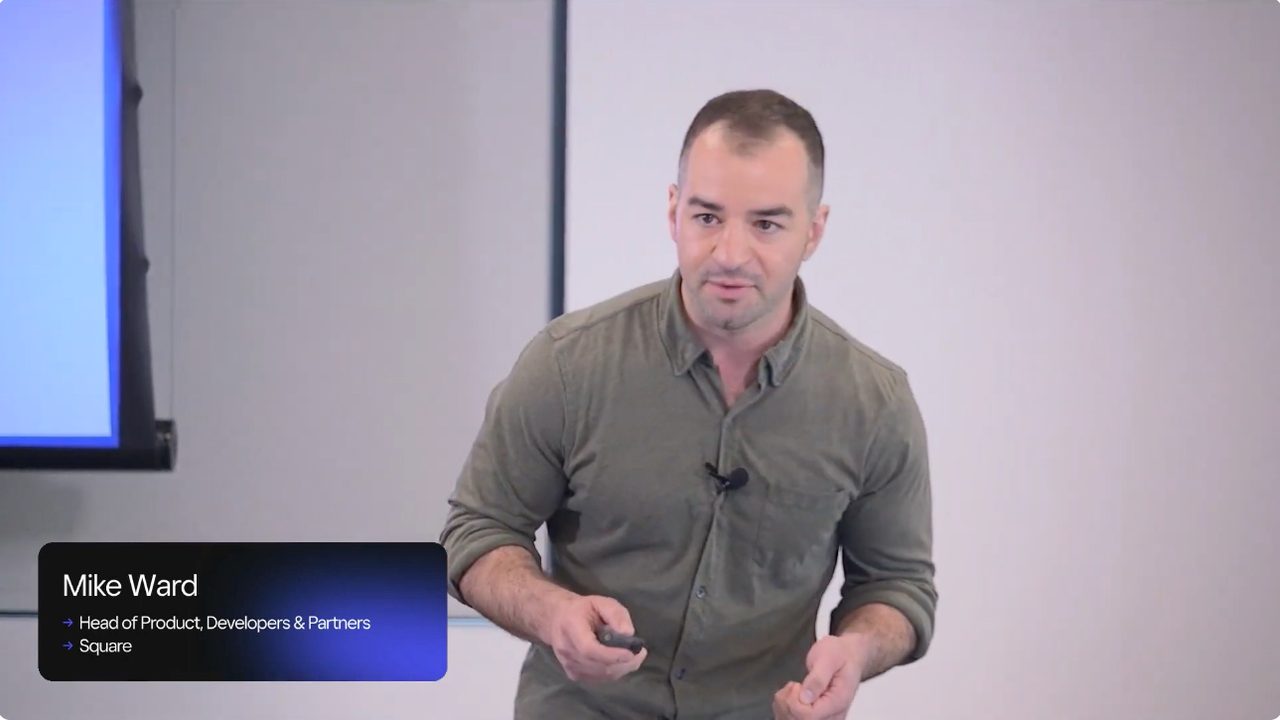
The keynote below is the public artifact of this era — the state of the platform, including the recommendations work, presented at Square's developer and partner conference.
What I'd do differently
- Rewrite the operating model in year one, not year two. I inherited the convergence coupling and worked within it longer than I should have. The evidence that it was the binding constraint existed on day one; the standing to challenge it, I had to build. I'd spend that standing faster.
- Instrument the seller journey before I needed it in a fight. The churn interviews and funnel analysis that won the recommendations argument were assembled under pressure. The org should have had that evidence as a standing capability, not a war effort.
- Tell the "multiples" stories with public numbers from the start. The results in this memo are stated as multiples because the precise figures are Block's, not mine. The lesson for any platform leader: build the public proof — filings, keynotes, press — alongside the work, so the record can speak at full resolution later.