← All projectsPrivacy-first · Zero-knowledge · Android · Kotlin
Monk — the focus app that couldn’t leak your data if it tried.
Focus apps have a dirty secret: they keep you watched so you’ll stay engaged. Monk
inverts the deal. It silences 25 messaging apps and answers on your behalf while
you’re heads-down — and it ships without the one permission every surveillance
business depends on. No internet access. No account. No analytics. Not as a promise in a
policy, but as a fact the operating system enforces at install time: the entire app is
1.4 MB of open-source Kotlin that processes your messages in memory and forgets them.
And because the privacy is architecture rather than branding, it’s a foundation — a
zero-knowledge core any developer can rebrand and build a privacy-first product on.
Product judgment under real constraints. A privacy claim is only worth anything if a stranger can verify it — so the network capability was removed at the operating-system level rather than promised away in a policy. The audit is one line: the manifest has no INTERNET permission.
Range through restraint. Auto-reply across 25 messaging apps through Android’s own quick-reply channel, a focus session that survives process death and reboots, and a whole product in 1.4 MB — no backend, no third-party SDKs, ~4,200 lines of Kotlin.
An honest register. The page carries its own scope ledger; when earlier drafts disclosed unwired settings, the fix went into the public repo before the claim went onto this page.
One tap. The orb turns, the countdown starts, the phone goes quiet.
The problem
The productivity category has a conflict of interest at its heart. Focus apps make money
by knowing you — accounts, cloud sync, streaks, behavioral analytics. To sell you
concentration, they meter your attention. Meanwhile the phone keeps swinging: studies log
60–90 notifications a day per person, knowledge workers get interrupted roughly every two
minutes, and a genuine interruption costs about 25 minutes of depth. The tool that fixes
this should be the one app on your phone with no angle.
People feel the conflict even when they can’t name it. 81% of Americans say
they’re concerned about how companies use their data; 73% say they have little or no
control over it (Pew, 2023). And the category leader in Android auto-reply — 7 million
downloads — declares right in its own store listing that it may collect and share your
location and app activity, and pipes conversations through cloud AI by design. The market
answer to “help me be unreachable” is an app that watches you.
Monk’s answer isn’t a better privacy policy. It’s the removal of the
capability. When Pew analyzed a million Play Store apps, 83% requested full network
access — and that was a decade ago. Monk sits in the sliver that never asks. The promise
“your messages never leave your phone” isn’t marketing copy; it’s a
permission the operating system was never granted, and anyone can check.
That discipline generalizes. Everything Monk does — intercepting notifications, replying
in place, running sessions that survive reboots — is a reusable pattern for any developer
building software for people who cannot afford to be watched. The core is MIT-licensed
precisely so it can be taken.
Who it’s for
The deep worker
Imagine you’re shipping something hard and your phone takes ninety runs at your
attention a day. You don’t need another dashboard about your habits — you need the
pings answered and silence until you surface. Interruptions hit knowledge workers about
every two minutes, and each real one costs ~25 minutes of depth. Monk is for the overlap:
people who want focus without buying it with surveillance.
The person being watched at home
Imagine the person who monitors your phone is someone you live with. In a 2025 global
study, 45.7% of adults reported experiencing some form of tech-enabled abuse in the past
year, and stalkerware detections run in the tens of thousands annually. For a survivor,
every app is a question: what does it store, and who could make it talk? Monk’s
answer is structural — it stores no messages, keeps no history, and has no server to
subpoena, breach, or coerce. It isn’t an anti-stalkerware tool, and it doesn’t
claim to be; what it offers is narrower and provable: an app that holds nothing and
transmits nothing adds zero new attack surface to a life that can’t afford any.
The journalist and the source
Imagine your contact list is the story. At least 180 journalists in 20 countries have
appeared on commercial spyware target lists. People in that world audit permissions before
they install anything — and Monk is the rare app that passes the audit in one line:
no INTERNET permission.
“Nothing transmitted, ever” is a claim a security desk can verify in thirty
seconds.
The developer who needs this foundation
Imagine you’re building for any of the people above — a therapist-referral app, a
shelter’s check-in tool, a newsroom utility — and privacy isn’t your feature,
it’s your precondition. Monk’s core is the head start: an OS-enforced
no-network boundary, an in-memory message pipeline, and session infrastructure that
survives reboots. MIT-licensed. Rebrand it, build on it, keep the guarantee.
Product journey
Three days, and one decision
Day one: the obvious build. Scaffold the whole app the way anyone would —
SMS auto-reply through
RECEIVE_SMS,
SEND_SMS, and
READ_SMS, a Room
database on standby, cloud backup enabled by default. It worked. It was also three scary
permission prompts and a datastore away from being every other app.
Day two: the inversion. The realization that notifications already carry
a reply channel — Android’s RemoteInput — so SMS auto-reply needs zero SMS
permissions; you answer a text by answering the Messages notification. The same day, the
whole posture flips: SMS receiver deleted, Room deleted, backups switched off, and the
commit message says it plainly — “Zero-Knowledge architecture.” Deep
Focus, Do-Not-Disturb integration, boot resume, and 25-app support land in the same push:
four thousand lines in a day.
Day three: the subtraction pass. The rare cleanup that removes more than
it adds — net −453 lines. Release builds strip every log call; debug logs redact
senders; the notification listener loses 150 lines of scaffolding. Restraint, applied to
the codebase itself.
Then the positioning caught up. An MIT license, a README that leads with
the conviction, and — most recently — a wiring pass that closed the gaps this page’s
own earlier draft disclosed. The product didn’t change direction once; it just kept
deleting things that betrayed the rule.
A single, calm loop
Using Monk takes four verbs. Onboard — three screens: the idea, the
privacy promise, and the one permission it actually needs (notification access;
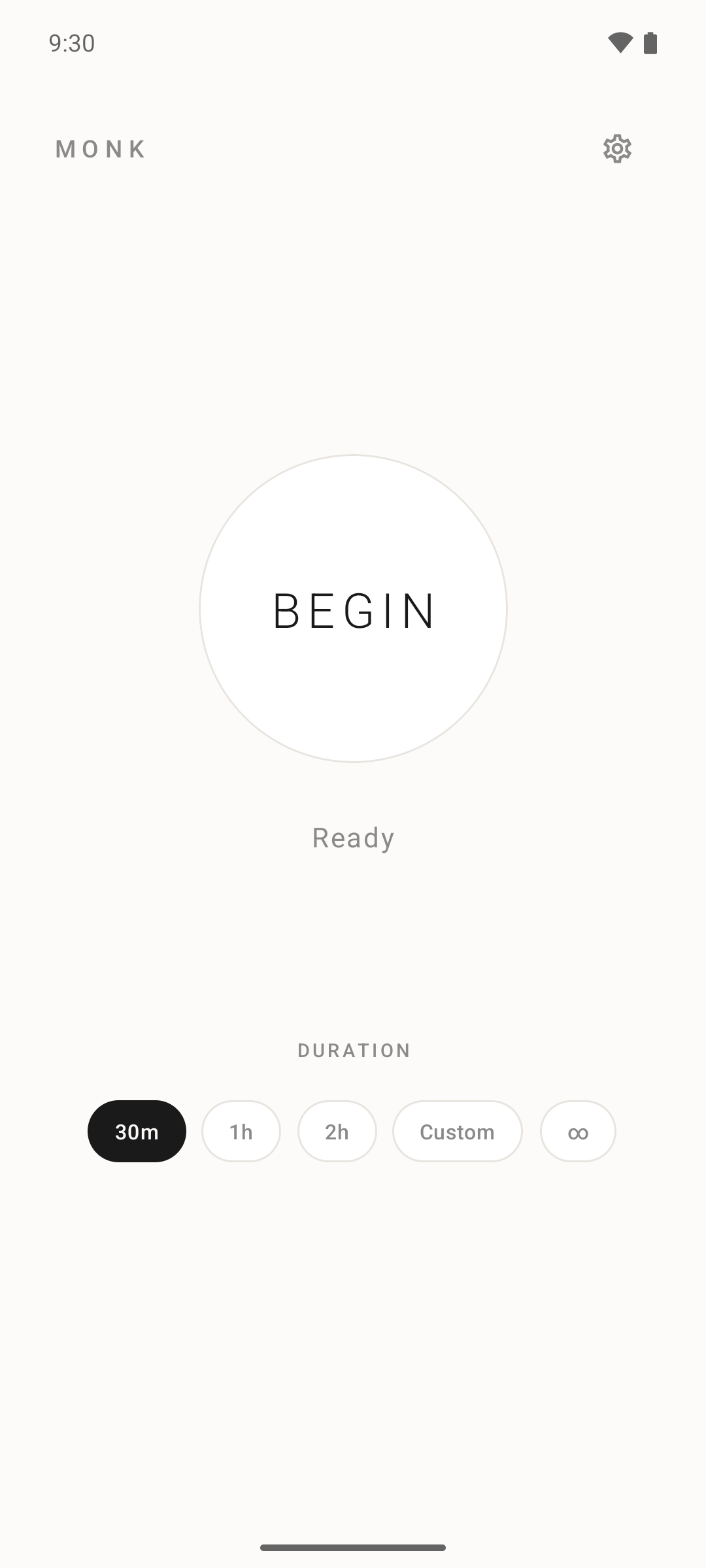
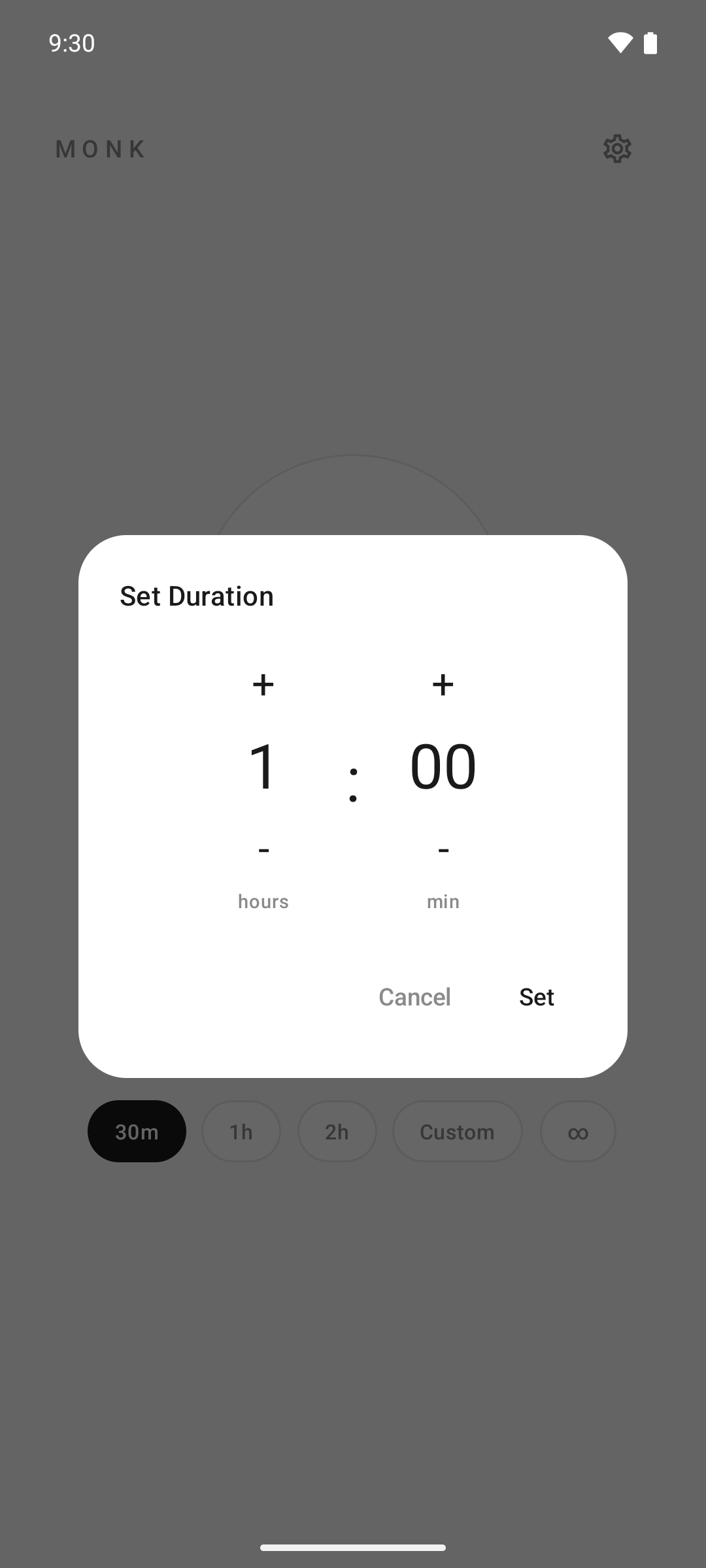
everything else is optional and asked for in context). Begin — pick
30 minutes, an hour, two, a custom stretch, or infinity, and tap the orb.
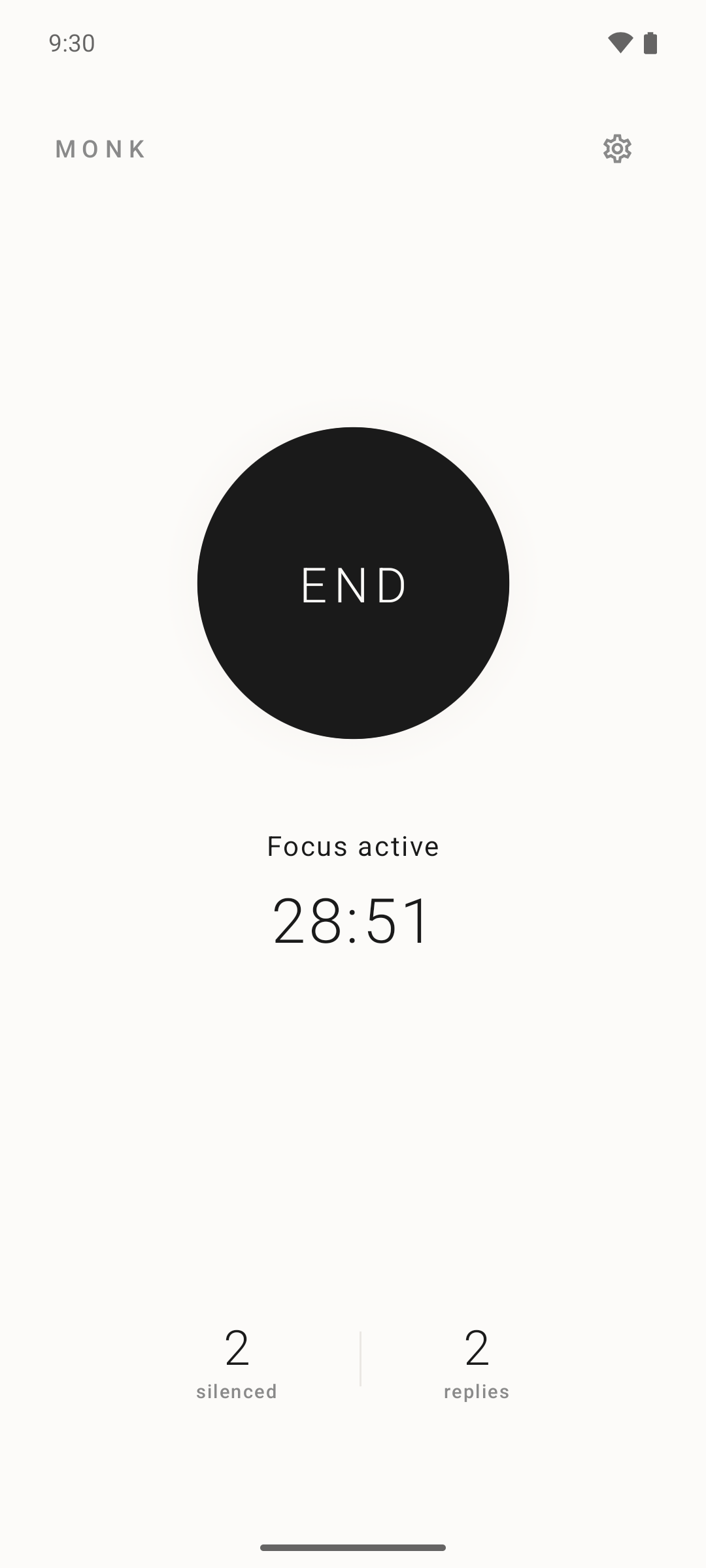
Focus — the orb turns ink-black, a countdown runs, and two live
counters tally the messages silenced and replies sent on your behalf; optional
Do-Not-Disturb silences the phone itself, and an optional Deep Focus mode walks you
back when you wander. End — tap again: DND is restored, the counters
die with the session, and nothing is remembered.
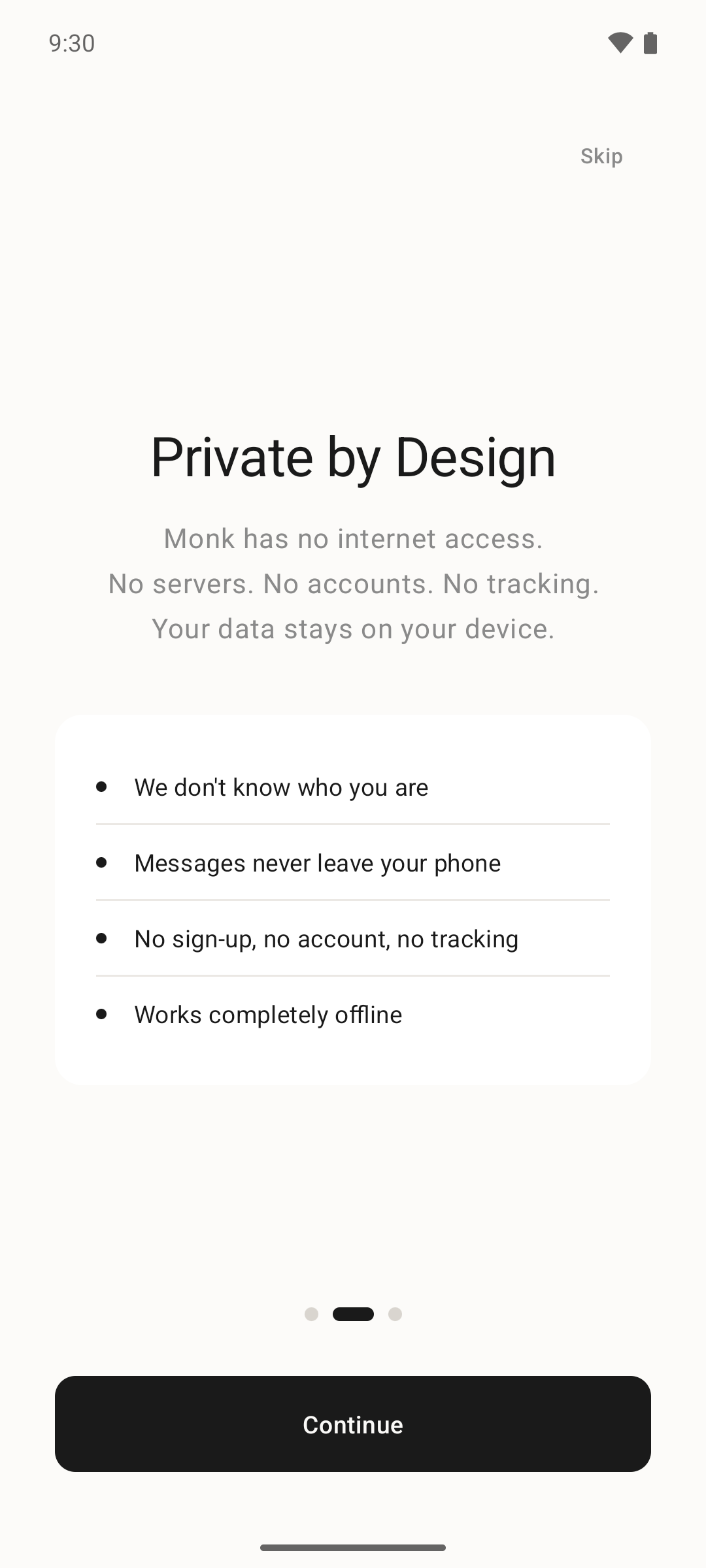
The onboarding page shown here is the whole pitch in four lines — we don’t
know who you are; messages never leave your phone; no sign-up, no account, no
tracking; works completely offline. Every engineering decision on this page
exists to keep those four sentences true.
Onboarding — the four promises the architecture must keep.
Design principles
Subtraction is the feature. SMS permissions: deleted. Room database:
deleted. History screen: never built — the navigation code carries the comment
“Privacy: No History screen — we don’t store message history.”
The best cleanup commit removed 453 more lines than it added.
Claims the OS enforces beat promises a policy makes. No
INTERNET permission;
allowBackup=false;
cleartext traffic disabled. The strongest privacy statement in the repo is the absence
of a line in the manifest.
Hold nothing you wouldn’t want to explain. Messages are processed
in memory and dropped; the reply cooldown map is wiped every session; the whitelist
stores contact IDs, never names; the “silenced / replies” numbers are UI,
not analytics — they die with the process.
Ask for one permission; earn the rest. Onboarding requests exactly one
thing: notification access. Do-Not-Disturb, accessibility, and contacts are optional,
requested in context, and switch on the moment the user grants them — no nagging
checklist screens.
Calm is a design system. One orb, two numbers, a monochrome
ink-on-paper palette with a single brass accent. The status notification updates every
60 seconds, not every second — even the battery is treated with restraint.
Say what’s unfinished. This page keeps an honest-scope ledger
(below), and when it lists a gap, the gap is real — and when a gap gets fixed, the fix
lands in the public repo before the claim lands here.
Architecture & tech
The architecture is defined by a boundary the app cannot cross. Everything happens
on-device: a NotificationListener intercepts messages and answers them
through Android’s RemoteInput channel, a foreground FocusService
owns the session (timer, counters, boot resume), an optional
AccessibilityService handles Deep Focus and a best-effort reply
fallback, and DataStore holds 13 settings keys — zero message content.
There is no network tier because there is no network permission. And the honest answer to
“where’s the backend?” is: there isn’t one, anywhere, and that is
the product.
Signal sources
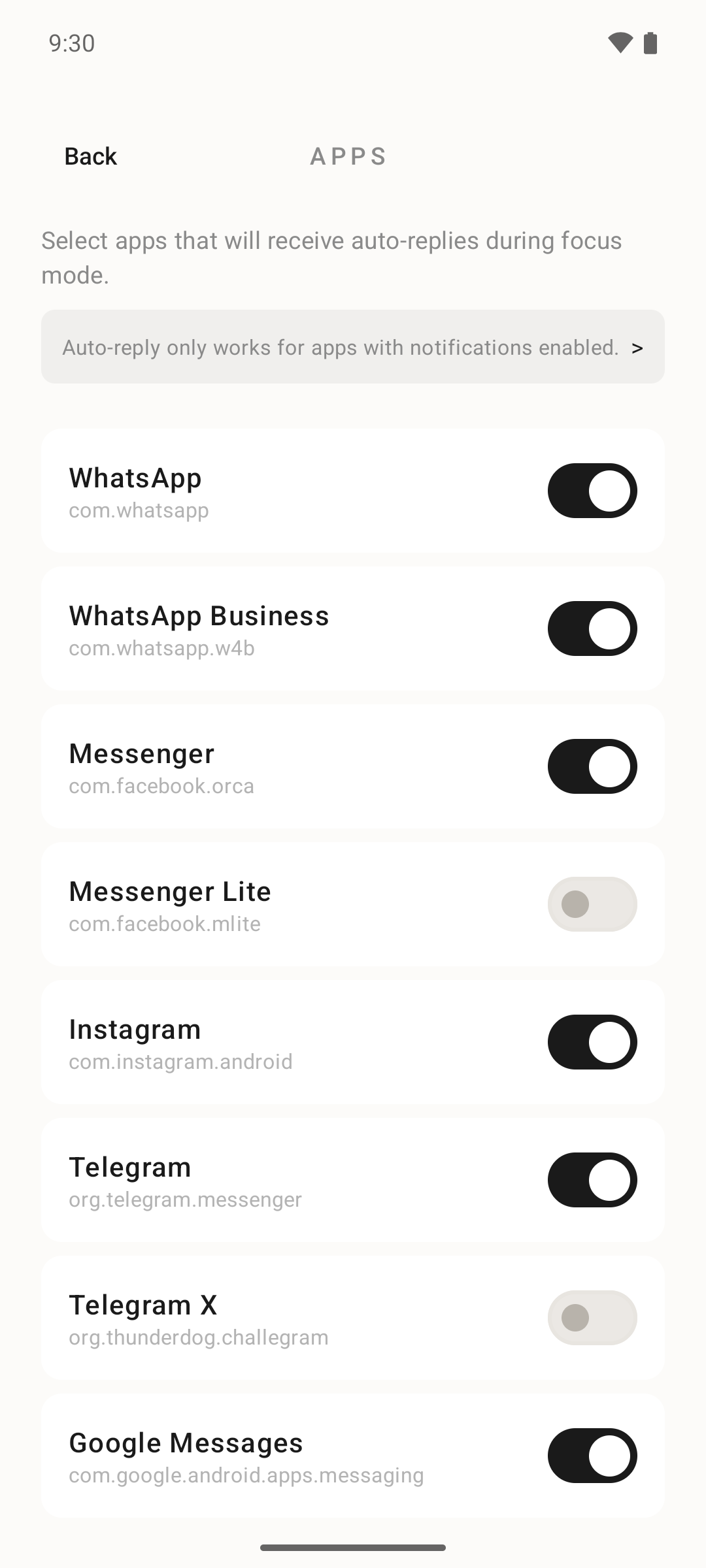
25 messaging apps
WhatsApp · Signal · Slack Telegram · Messages …
Android notification pipeline
the only input Monk consumes
Network
INTERNET permission: never declared verify: aapt dump permissions
✕ absent by construction
Zero-knowledge core · on device
NotificationListener
extract → guard → reply via RemoteInput → dismiss
AutoReplyManager · WhitelistManager
per-sender cooldown · contact pass-through session-scoped, in memory only
FocusService
special-use foreground service timer · counters · 60 s notification cadence
AutoReplyService
AccessibilityService: Deep Focus + best-effort reply fallback
BootReceiver
resumes a live session after restart
⟳ wall-clock resume math
prefs
Local state & system
DataStore
13 preference keys zero message content · no database
Ecosystem railGitHub (public, MIT) · Gradle + ProGuard release pipeline (log-stripping, 1.4 MB minified APK) · Pixel emulator + sideload distribution · no Railway, no Sentry, no Postgres — nothing to operate is the point
Notification in → in-memory pipeline → reply out through the same notification. Data never leaves the phone.
An app with no telemetry can’t page anyone when it breaks — so it has to be built
not to break, and small enough to audit instead of monitor. Monitoring is inverted here:
the operating system is the watchdog, the user’s own device is the dashboard, and
the codebase — 4,217 lines of Kotlin across 21 files — is short enough to read in an
afternoon.
1.4 MB
Release APK — smaller than one photo (the unminified debug build is 15.2 MB; R8 earns its keep)
~0.5 s
Cold start, measured on a Pixel 8 emulator (API 36, software rendering — retail hardware should do better)
0 bytes
Transmitted, ever — no network stack exists to measure
Resilience is engineered rather than observed. The session runs in a special-use
foreground service with START_STICKY
restart semantics; the session’s three facts (active, start time, duration) are
persisted the moment it begins, so a reboot mid-session resumes with the correct
remaining time — verified on the emulator: restart the phone and the countdown
picks up where the wall clock says it should, and a session that expired while the phone
was off is detected and cleared rather than resurrected. A battery-optimization check
deep-links to whitelist the app on aggressive OEMs.
The crash surface is thin by construction: no network stack, no database, no serialization
layer, no third-party SDKs beyond AndroidX and Hilt — the categories that generate most
production crashes simply aren’t present. Memory sits at ~21–37 MB PSS on the
same emulator, and the status notification refreshes every 60 seconds rather than every
second. The only statistics the product keeps — messages silenced, replies sent — are
computed on-device, shown to the user, and kept by no one.
Honest scope — true at the current HEAD
The fallback reply path is best-effort. When an app exposes no quick-reply action, Monk asks the accessibility service to type the reply — but that only works once the target app’s window is open. RemoteInput is the primary path and carries the product.
Whitelist matching is name-based. Whitelisted contacts are matched by the sender name on the notification; group-chat senders and apps that don’t title notifications with the contact name won’t match.
Not on the Play Store. v1.0 is built from source and sideloaded — distribution is the repo itself.
Performance numbers are emulator-measured (Pixel 8 AVD, API 36, software GPU), not retail-hardware benchmarks.
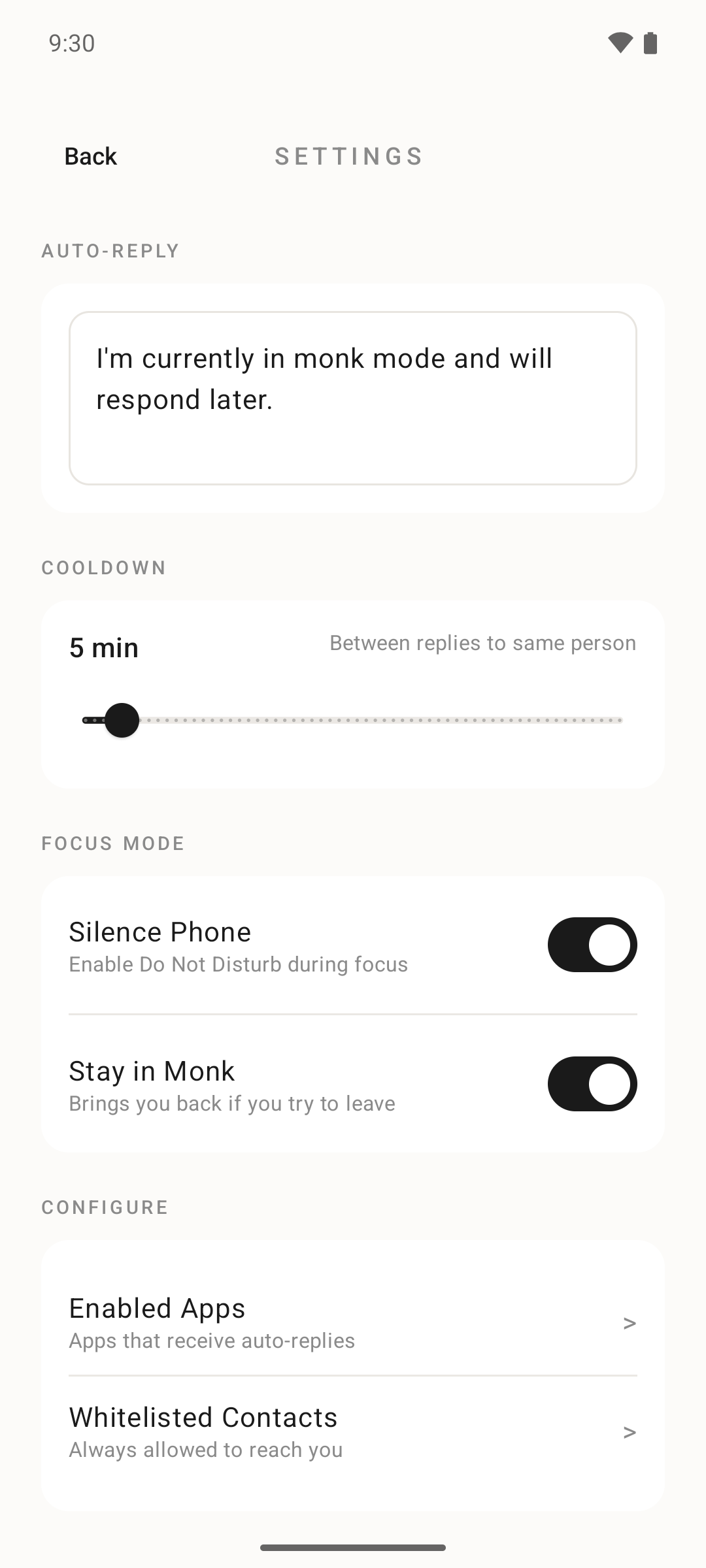
Recently closed: per-app toggles and the contact whitelist existed as UI without enforcement in v1.0’s first cut; a July 2026 wiring pass connected both to the listener and made reply text, cooldown, enabled apps, and the whitelist survive process death and reboots.
Challenging features
1 · Proving a negative
Every app says “we don’t collect your data.” Nobody can check. The bar
here was different: make the claim verifiable by a stranger in under a minute. The first
move is the boundary — don’t promise no exfiltration, remove the
capability. With no INTERNET
permission in the manifest, the kernel refuses the socket. 83% of Android apps ask for the
network; Monk can’t use it without shipping a new APK that any user could diff.
The second move is closing the side doors, one by one. Cloud backup is off
(allowBackup=false —
Android’s backup service would otherwise happily ship app data to Google’s
servers on its own). Release builds strip every log statement via ProGuard
(logcat is readable over adb; a leaked sender name in a log line is still a leak), and even
debug builds redact senders to M***
or ***1234. There is no
database and there are no files — device forensics find 13 settings keys, not
conversations. The third move is source: MIT-licensed, ~4,200 lines, rebuildable — the
audit is git clone plus
aapt dump permissions.
The result is a privacy claim built to survive a hostile security review: demonstrated,
not asserted.
The airlock: one pipeline inside an OS-enforced boundary, with every exit individually locked.
2 · Replying without reading
The naive way to auto-reply is spyware: scrape each chat app’s screen with an
accessibility service and type into it. The elegant way hides in plain sight. Any
notification with a quick-reply action carries a
RemoteInput — a system-blessed channel to answer through the
notification itself, uniform across WhatsApp, Signal, Slack, Telegram, and 21
more. No per-app SDK, no chat database, no message ever stored.
The quirks are where the work lived. Many apps tuck their reply action into the
WearableExtender
rather than the standard action row, so Monk probes wearable actions first. Every
RemoteInput key must be filled or the app rejects the intent. Group chats mangle
sender identity, so extraction falls back through summary text, “N
messages” titles, and colon-prefixed lines. And the answered notification must
be cancelled, or you surface from a two-hour session to a wall of already-handled
pings.
The demo here runs with the network hardware switched off in spirit and in fact: an
SMS arrives, Monk answers it through the Messages notification, the counters tick —
and the punchline is that SMS auto-reply uses zero SMS permissions.
Day one implemented RECEIVE_SMS
/ SEND_SMS /
READ_SMS the
invasive way; day two deleted all three, because the Messages notification already
carries the reply channel. Three scary permission prompts became zero.
Two texts arrive mid-session; Monk answers both. No SMS permission involved.
One uniform reply channel across 25 apps — and the deleted invasive path it replaced.
3 · The echo problem
Failure modes nobody thinks about until 3 a.m.: your own reply posts a notification,
and the listener answers itself, forever. Two people running auto-repliers ping-pong
until a battery dies. A chatty group thread collects fifteen “I’m in monk
mode” messages in a minute — congratulations, you’re a spam bot now. The
defenses are small and layered: a self-reply guard that recognizes and
skips Monk’s own words when they echo back; a whitelist gate that
lets chosen contacts through untouched; and a per-sender cooldown —
5 minutes by default, tunable from 1 to 60 — so each person gets one courteous answer,
not a barrage.
The detail worth a second look is where the cooldown ledger lives: in a plain in-memory
map, created when the session begins and destroyed when it ends. This is a rate limiter
designed under a constraint most infrastructure never faces — the ledger itself must
not exist after the session. Rate limiting that leaves no trace of who messaged you.
Three gates before a reply — and the rate-limit ledger that must not outlive the session.
4 · Deep Focus, without becoming the thing it fights
The uncomfortable fact: “bring the user back to the app” uses the same
API family as stalkerware. Android’s AccessibilityService can read every screen,
watch every field you type into, and harvest every chat. The design question
isn’t can you — it’s how little can you take.
Monk’s answer is verifiable in code. The service listens only for
window-state changes — which app came to the foreground, never what
is on it. When you wander mid-session, it walks you back with a 500 ms cooldown,
a firm hand rather than a seizure-inducing loop. The permission is strictly optional
and off by default; deny it and everything else works. The system settings dialog
explains in plain words what it does, and the service’s entire configuration is
a nine-line XML file anyone can read.
The contrast is the point: the same service could read every screen. It
configures itself not to — and the loop here shows the whole feature: press home,
land on the launcher for half a second, and Monk is back in front of you.
Deep Focus — leave mid-session, and Monk walks you back.
The capability surface versus the configured surface — restraint you can diff.
5 · A session that refuses to die
A focus session is a promise with a deadline, and Android is an environment that kills
processes for sport. The session has to survive the OS’s memory pressure, the
user’s reboot, and Doze’s clock games — without holding a wake lock like a
barbarian. The machinery: a special-use foreground service (Android
14’s FOREGROUND_SERVICE_SPECIAL_USE
with a declared focus_mode
subtype — the modern, policy-compliant way to stay alive) with
START_STICKY restart
semantics; the session’s three facts persisted the moment it starts; and a
boot receiver that recomputes remaining time from the wall clock. A
2-hour session with a reboot in the middle ends exactly two hours after it began — and a
session that expired while the phone was off is detected and cleared, never resurrected
as a zombie. Frugality is part of the reliability story: the timer is a single coroutine
delay, the notification refreshes on a 60-second cadence, and persistence costs three
DataStore keys, not a battery.
Failure injections against one timeline: killed, rebooted, expired — the session answers all three.
6 · The discipline of one screen
Every element on a focus app’s screen is a bid for attention — which makes
screen design a zero-sum game against the product’s purpose. Monk’s home
screen holds exactly four things: a word, an orb, a duration, and — in session — two
numbers.
The craft is in what the orb carries. Its entire state language is color and a
two-second breathing pulse: paper for ready, ink for focused, gray
for locked. Commitment gets one 50-millisecond haptic tap. Duration is five
pills, not a picker. The counters render in hairline-light type, and the palette is
near-black ink on warm paper with a single brass accent that appears almost nowhere —
restraint as a visual identity.
Just as deliberate is what’s absent: no tab bar, no streaks, no charts, no red
badges, no history screen. The absence of gamification is a feature with a straight
face — this app rewards you by not being interesting. Even the status
notification plays along, updating once a minute instead of once a second.
Mid-session — one orb, one countdown, two honest numbers.