← All projectsDeveloper platform · OAuth · Webhooks · SDKs
One API for DeFi yield — with the platform to match.
Fintechs are sitting on idle stablecoin balances that could be earning onchain yield.
Almost none has the blockchain team it takes to integrate and leverage the right
protocols. This is the missing layer: one REST API that turns the largest DeFi lending
protocols — into something any developer can integrate in an afternoon, with the keys,
webhooks, sandbox, and docs to prove it.
Product judgment under real constraints. It's built around where API integrations actually die — auth and key rotation, event delivery, rate limits, sandboxes that lie — the checklist a decade of running Square's developer platform teaches, applied to a brand-new domain.
Full-stack range with AI-native tools. Solo and end to end: the gateway, a full token lifecycle, Svix webhooks, request logs, SDKs, and a docs site with live playgrounds — 444 commits, ~50k lines, public and MIT-licensed.
An honest register. The repo relabeled itself a reference implementation and stripped its own inflated claims; every number on this page is repo-citable, and the dead ends are documented next to the wins.
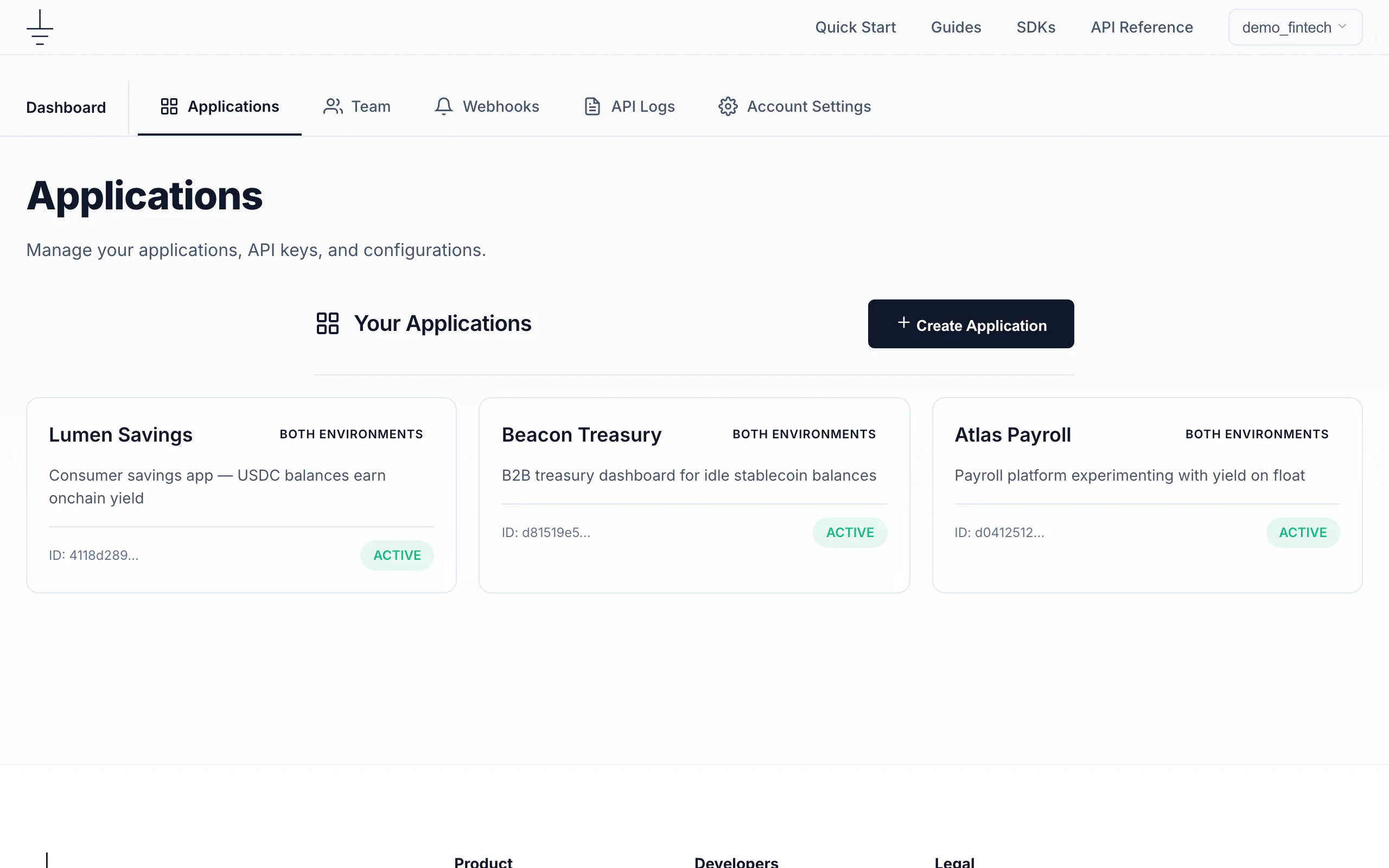
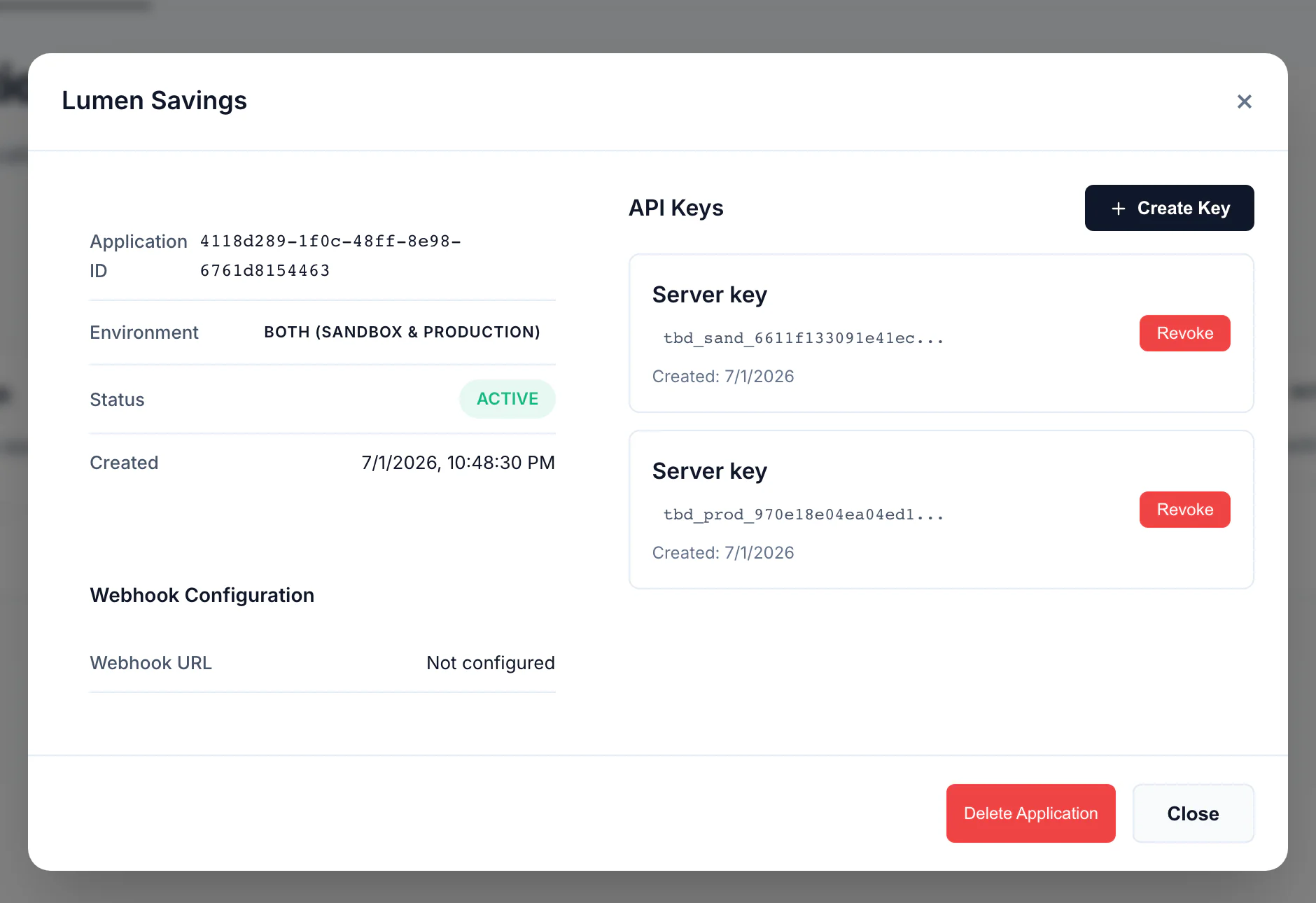
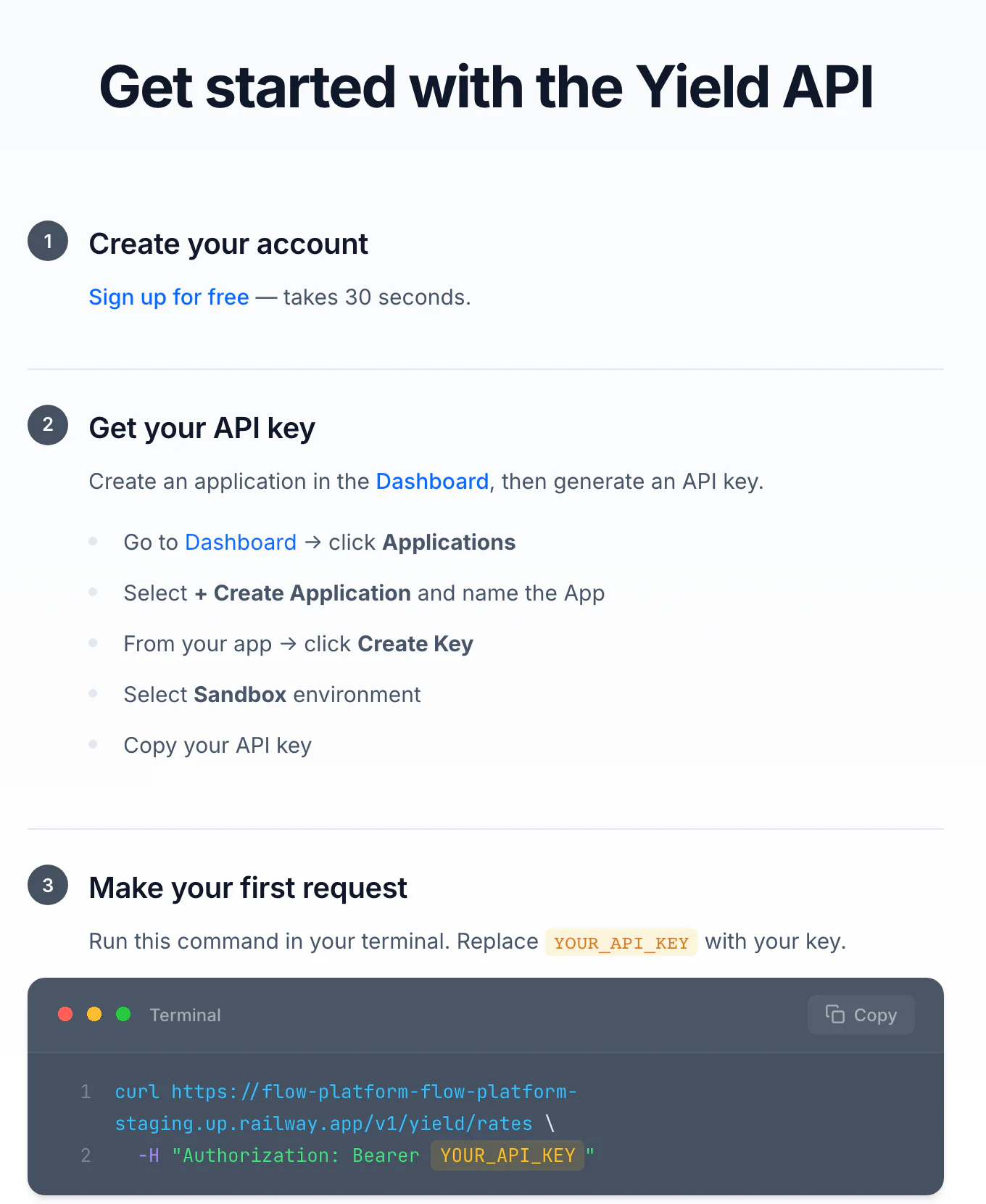
Self-serve, no human in the loop: create an application, mint a key, get a copy-ready request. The key says tbd_sand_ because the environment lives in the credential.
The problem
Onchain lending pays 3–8% on USDC. The two largest protocols alone — Aave (≈$14.6B in
deposits) and Morpho (≈$11.8B, both mid-2026) — hold more capital than most banks, and
every fintech with idle customer balances wants a piece of it. Regulation just made the
shape of the answer specific: the US GENIUS Act and the EU's MiCA both bar stablecoin
issuers from paying interest directly, so the yield has to come from a separate service
layer. An API. A category that, so far, has been led largely from Europe.
The supply side is hostile. Every protocol is its own smart contracts, its own chains,
its own rate semantics and failure modes. Integrating one is a project; integrating
several is a team — and that's exactly the team almost no fintech has.
The naive answer is "just wrap the protocols." It misses where integrations actually
die. Not on the happy path — on auth and key rotation, on event delivery, on rate
limits, on environments that lie, on debugging someone else's 401 at 2 a.m. The
unglamorous parts are the product.
I spent a decade running developer-platform infrastructure at Square, which teaches you
precisely which parts those are. This project applies that checklist, end to end, to a
domain that has never had it. The craft is old; the domain is new.
Who it's for
The founder about to bet a company on this space. Before the term
sheets, someone has to know whether "yield as an API" is actually buildable by a small
team — and where the dragons are. A slide can't tell you. A Figma can't tell you.
Building the entire surface, end to end, is the only honest way to find out. That's the
true origin of this project: a working answer to "how hard is this, really?"
The fintech developer. They will judge the platform in the first
fifteen minutes: how fast to a key, how good the errors, whether the sandbox lies. Every
decision below is aimed at those fifteen minutes.
The platform engineer. They want a reference for how the pieces —
tokens, webhooks, limits, logs, access control — compose in real code they can clone
and run. The repo is public and MIT-licensed for exactly that reason: 444 commits over
72 active days, ~50k lines, with the dead ends left in. Its last act before this page
was relabeling itself a reference implementation, which is what it is — a demonstrative
build, not a company.
Product journey
From zero to yield, in five beats
Sign up, get keys, instantly — a self-serve account, an application, and a tbd_sand_… key in under a minute. No sales call, no human.
See real rates in one call — GET /v1/yield/rates returns live APY from Morpho and Aave, fetched in parallel: ~200 ms today, down from 2,382 ms.
Move (pretend) money — deposits and withdrawals run against the sandbox and balances update. No real funds move, ever — verifiable in the code, where the onchain calls exist and are deliberately never wired in.
Get told, don't poll — Svix-delivered webhooks with signatures and retries, plus a portal that shows every delivery and lets you replay failures.
See everything you did — 7-day request logs with status, latency, and filters, and rate-limit headers on every response so you're never surprised.
The sequence is deliberate. A developer decides whether to bet on a platform in their
first session, and the beats are ordered by what they'll actually do: get a credential,
see real data, write something, get told about it, and then check the tape when
something looks off. Every beat works today against the live sandbox — the same one
linked at the top of this page — and the first beat costs less than a minute because
nothing in it waits for a human.
The dashboard a developer lands in — applications, keys, and configuration, all self-serve.
Design principles
These aren't aspirations — each one is checkable in the repo.
1 · The contract is the product. Stripe-style structured errors —
{ error: { code, message, type, param } } —
are in the very first commit, not a retrofit. Versioned paths
(/v1/), environment-prefixed
keys, rate-limit headers on every response. The parts of an API you can't change later
were decided first.
2 · Buy the undifferentiated, build the differentiating. Webhook
delivery went to Svix — retries, signatures, and a debugging portal for one dependency.
Access control was built by hand, because "users span businesses" was the
differentiator. Both calls get their own deep-dives below.
3 · Secure by default, even in a prototype. 15-minute access tokens
with rotation. Refresh tokens stored only as HMAC-SHA256 hashes. BCrypt passwords. Login
limited to 5 attempts per minute by IP, with account lockout. Wallet keys under
AES-256-GCM envelope encryption. One hardening commit reads like a checklist of things
prototypes skip.
4 · The sandbox must not lie. Same API, same shapes, Sepolia instead of
mainnet, keys that say sand
in the credential itself, test fixtures in one call — and user-facing "staging" was
renamed "sandbox" everywhere, because developers trust the word.
5 · No real funds move — as an engineering decision, not a disclaimer.
The mainnet contract clients exist in the codebase, with real addresses, and are
deliberately never called from the money paths. The safety property is structural, not
a config flag.
6 · Say what's true. The repo's last act was relabeling itself a
reference implementation and stripping its own inflated claims. This page inherits that
standard: every number below is repo-citable, and the dead ends are documented next to
the wins.
Architecture & tech
A vanilla-JS frontend on Cloudflare Workers serves the docs and
dashboard. The gateway is Kotlin/Ktor on Railway: a fixed middleware
pipeline — CORS, rate limiting, async request logging, auth — in front of ~80 route
handlers, all speaking the same Stripe-style error envelope with a
req_ ID minted per
request. Services sit on PostgreSQL (18 tables, code-first Exposed
schema, HikariCP). Yield data comes from Morpho Blue and
Aave V3 over GraphQL, fetched in parallel with retry and backoff. The
Web3j contract clients for both chains are present — and unwired from every money path.
Consumers
Developer apps
REST · tbd_* API keys rate-limit headers on every response
A developer platform is judged on the days it fails — so the observability was built
before there were any developers to observe. Every request is logged asynchronously
with its duration; every response carries
X-RateLimit-* headers
(100/min default, 5/min on login, 300/min on health) and a
Retry-After on 429;
Sentry is running in production, sampling 20% of transactions there and 100% in the
sandbox.
2,382 → ~200 ms
GET /v1/yield/rates — sequential, then parallel fetches
91%
Deploy success on Railway — 392 of 431 since Nov 2025
7 days
Request-log retention, enforced by a cleanup job every 6 h
The 10× commit
The best performance story in the repo is one commit. The first version of
/v1/yield/rates asked
Morpho, waited, then asked Aave — and each client carried its own generous retry policy,
so a slow upstream didn't just add its own latency, it multiplied it. Total: 2,382 ms
for two GraphQL calls. The fix was almost embarrassingly small: fetch both protocols in
parallel and tighten retries to two attempts with a 50 ms initial backoff. Same
data, ~200 ms. The lesson wasn't "go parallel" — it was that latency compounds at
the seams between services, and you find it by measuring, not by reading the code.
The same two upstream GraphQL calls — sequential with stacked retries, then parallel with tightened retries: 2,382 ms → ~200 ms.
Health is layered: a /health
endpoint, a Docker HEALTHCHECK
every 30 seconds, Railway's own healthcheck path, and restart-on-failure capped at ten
attempts. The live sandbox answers /health
in 0.2–0.3 s from a cold external client — an anecdote, not a benchmark. On
Railway, the API service has been deployed 431 times since November 2025 (39 failed
builds — a 91% success rate), and the Postgres instances have run untouched since
January 2026. Upstreams age too: in mid-2026 the Morpho API renamed a field and half the
rates quietly zeroed — found and fixed while preparing this page, which is exactly the
kind of decay a rates API signs up for.
Honest scope: the rate limiter is a single-node, in-memory sliding window — the
architecture doc names Redis as the scale path.
/health deliberately
skips the database check. Request and response bodies are deliberately not stored. And
the logs themselves are a product feature, not just ops — they get their own deep-dive
below.
Challenging features
Eight problems carried most of the engineering weight. For each: the problem, the naive
approach, why it broke, where it landed.
1 · Documentation developers — and now machines — can actually use
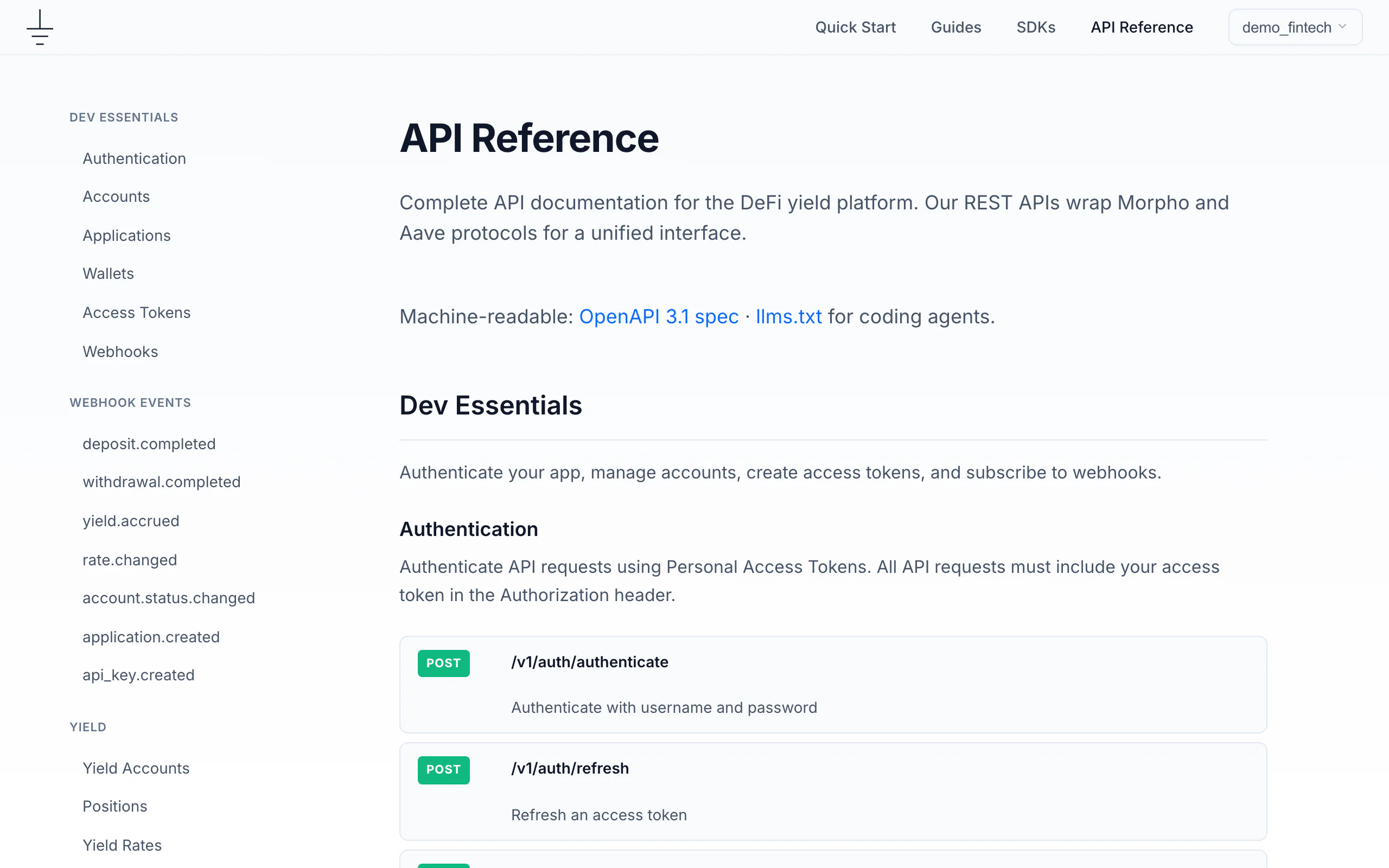
The docs shipped as a full system, not a README: quickstart, getting-started, guides,
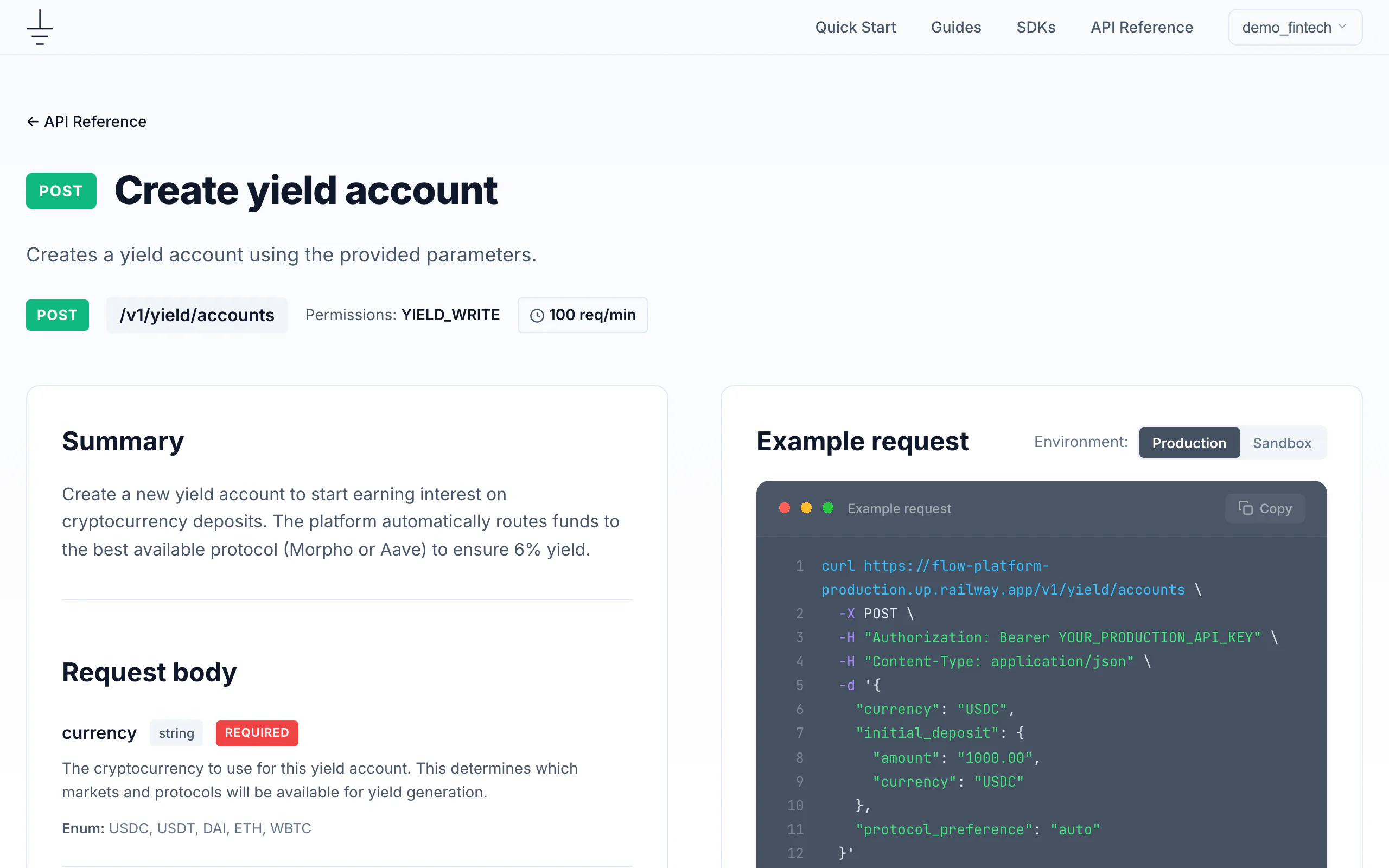
an API reference with interactive per-endpoint pages (~26 endpoints
with parameters, curl samples, and live environment-aware examples), an SDKs page
with live code playgrounds, and a status page. One toggle flips every code sample on
every page between production and sandbox URLs and keys.
The SDKs exist for a specific reason: the three embeddable TypeScript components
(Applications, Wallets, Yield Accounts) let a partner mount whole platform surfaces
as drop-in components instead of rebuilding CRUD UIs against the raw API. Honest
scope: they're handwritten iframe-embed components with live playgrounds — not
generated client libraries, and not published to a package registry. The docs say
what they are.
Then 2026 moved the bar: developers' coding agents now read docs before humans do,
and the industry answer — llms.txt plus an OpenAPI spec — is being shipped by
Stripe, Anthropic, Vercel, and Cloudflare. This repo's docs were human-excellent and
machine-opaque: the endpoint catalog lived in bespoke JS. So the gap got closed
before this page shipped — an OpenAPI 3.1 spec covering the
documented endpoints and an llms.txt at the docs root, linked from
the reference. The honest version of "AI-ready docs" is shipping them, not claiming
them.
Every endpoint gets an interactive page — parameters, shapes, and a live env-aware example.Six surfaces for humans; llms.txt and an OpenAPI 3.1 spec for the agents — fed by the one hand-kept endpoint catalog.
2 · Defining the API — and renaming everything, twice
The whole platform landed in one initial commit with Stripe's error taxonomy already in
place — the API contract was designed before the product had a name that stuck. Then
reality: the project was rebranded twice, and each stratum is still visible at HEAD —
the flow-api/
directory from the first name, the
tbd_ key prefixes
from the second, three brands fossilized in one codebase. I'm keeping it; it's true, and
it's the most honest diagram of how products actually get named.
What matters is what didn't move. The error envelope, the
/v1 versioning, and
the environment-in-the-credential key design are commit-one decisions that survived
every rename — and survived the one genuinely disruptive pivot, when the resource model
split "accounts" into users and businesses to make room for the access-control system
in deep-dive 7. That's the test of a contract: the product changed names twice and
changed shape once, and no integration would have broken.
The dead ends are instructive too. Custom API domains were attempted and reverted twice
("not configured yet" — the honest URL is the Railway one). And the day-one spec
documented cursor pagination that was never implemented: documentation fiction, the
exact failure a contract-first culture is supposed to prevent, sitting in my own spec.
It's called out here because a platform that will lie to you about pagination will lie
to you about anything.
Two renames later, the contract never moved — the error envelope, /v1, and env-prefixed keys are commit-1 decisions still at HEAD.
3 · Webhooks — the build-vs-buy call
An API that only answers questions forces developers to poll; events are table stakes.
The repo has the fossil of the naive approach: a
webhook_url column, a
whsec_ secret, and a
/v1/webhooks stub that
returned [] for eight
weeks. It stayed a stub because reliable delivery is not a POST — it's retries with
backoff, dead-letter queues, signing and replay protection, SSRF defense, per-endpoint
logs, and a UI where customers debug themselves. Each of those is a project.
Sending an HTTP POST is easy; delivering it reliably at scale is not — and delivery
isn't the differentiator of a yield API. So the call was to buy: one Svix integration
(+1,594 lines) traded all of those projects for one dependency and one env var — seven
event types registered on boot, one Svix application per account, HTTPS-enforced
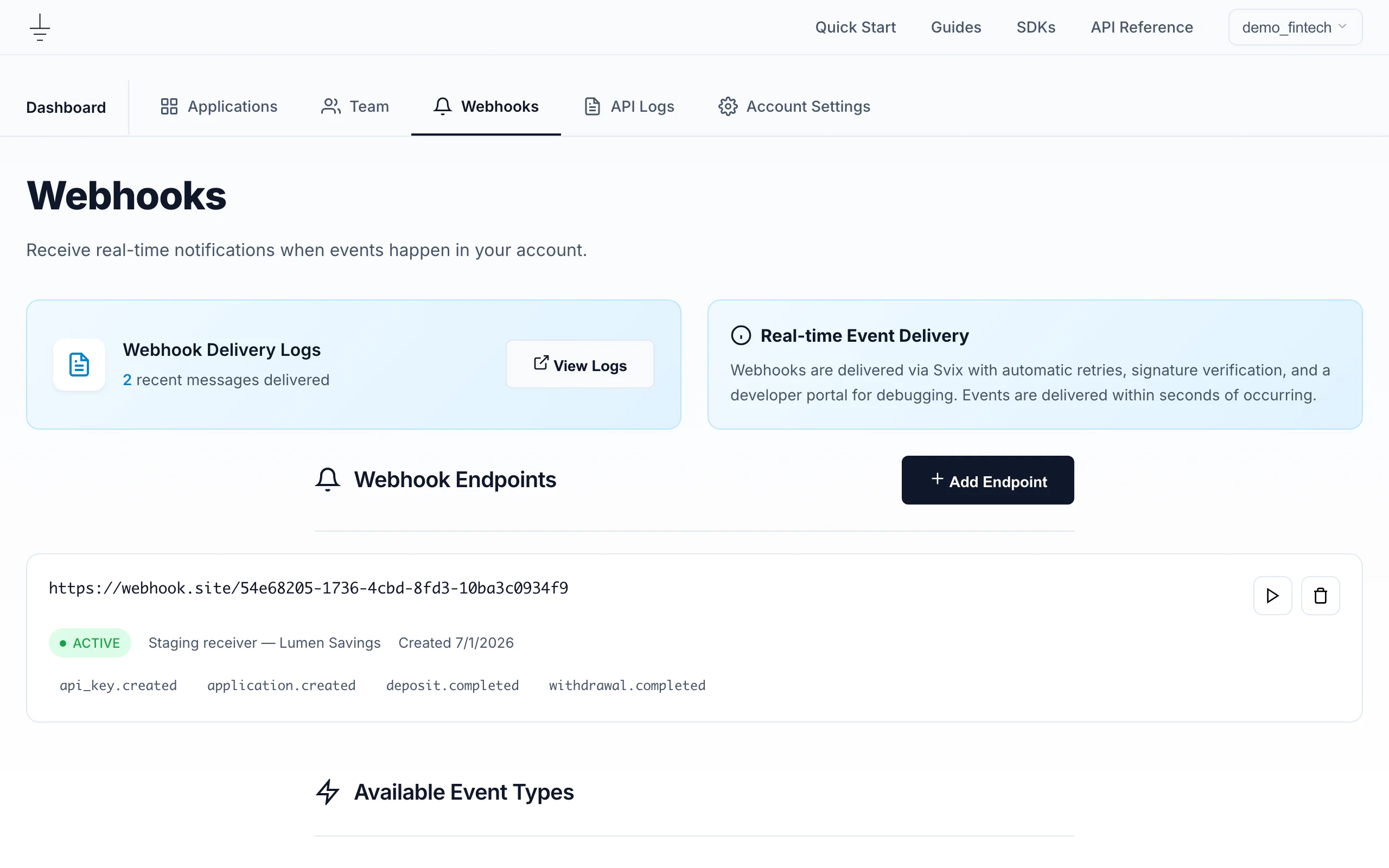
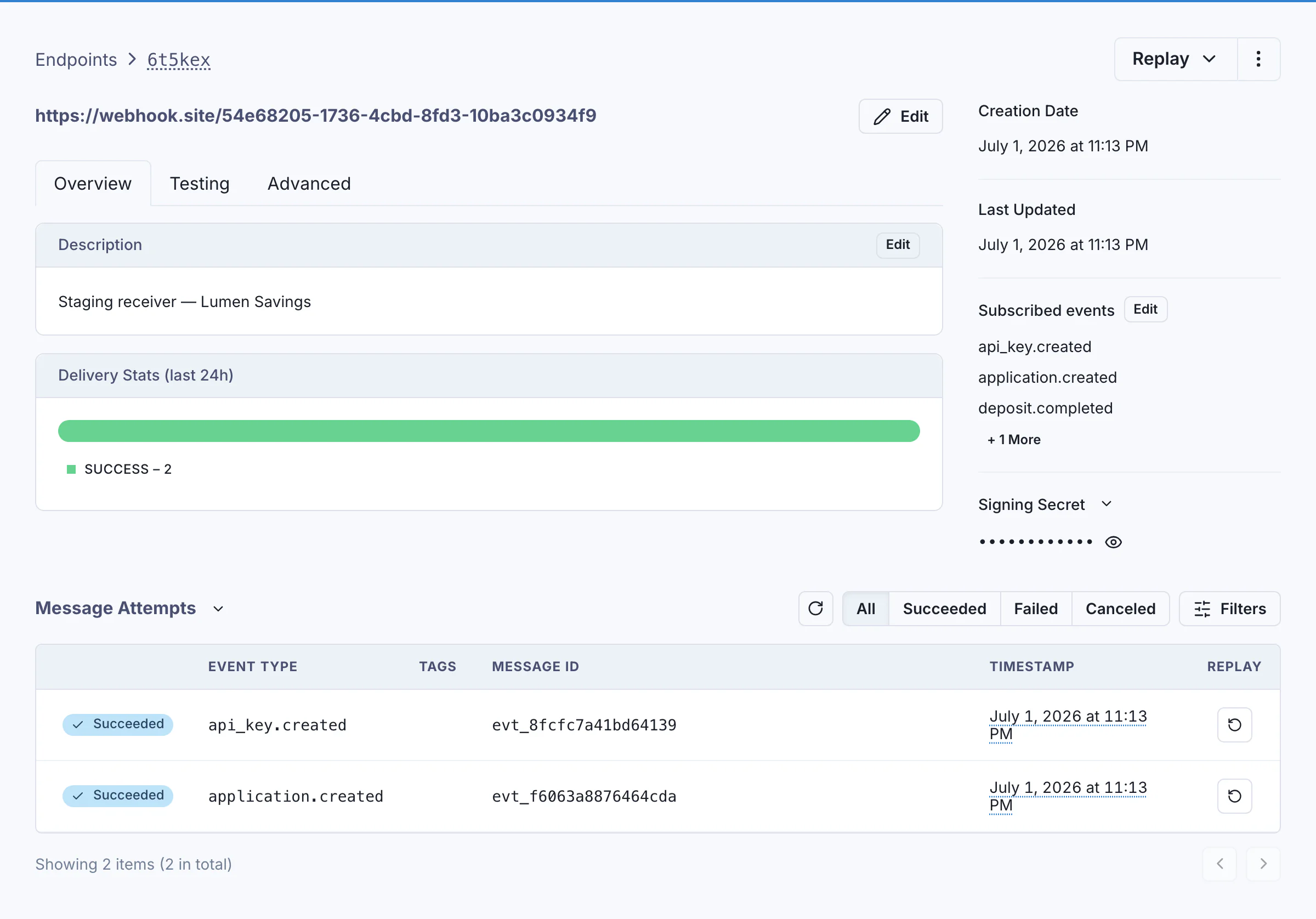
endpoints, test sends, and the App Portal embedded so every developer
gets delivery logs and manual replay without me building a debugging UI. The economics
only work because the boundary was drawn where the differentiation ends: events are
table stakes, so they're bought; access control is the product's edge, so it's built.
Battle scars, for honesty: the Svix SDK 1.30 upgrade broke and was reverted to 1.16,
and only four of the seven event types have live triggers today — the other three are
declared but not yet fired. The screenshots below are real deliveries against the live
sandbox, signed and acknowledged.
Delivery went to Svix — signing, retries, dead-letter, and a portal for free; the self-built path never got past a stub.Endpoints, subscriptions, and recent deliveries — live against the sandbox.The App Portal every developer gets — delivery stats, signing secret, per-message replay.
4 · A sandbox that tells the truth
A developer's first real action is against the sandbox. If it lies — different
shapes, stale data, mystery auth — they leave and never tell you why. So the sandbox
here is not a flag in one database: it's two parallel Railway
deployments, each with its own Postgres, its own env vars, its own
/health. The
ENVIRONMENT
variable drives Sepolia (chainId 11155111) versus mainnet (chainId 1), and keys are
born environment-scoped with the environment readable in the prefix.
One service call bootstraps a test app, wallet, yield account, and a never-expiring
test token — resettable fixtures, one request. The docs flip every example between
environments with a single toggle, so what you read is what you'll call. (Full
disclosure: the Sepolia contract addresses are still zeroed placeholders — which is
fine, because nothing calls them; the sandbox's truth is in its shapes and
behavior, not in testnet theater.)
The semantic core: deposits update balances and fire the same webhooks production
would, while the real contract clients sit unwired. And one naming decision carried
product thinking: user-facing "staging" was renamed "sandbox" everywhere — staging
is yours; a sandbox is theirs.
One toggle, every sample: the docs flip between sandbox and production in place.Two full stacks, one contract — only the chain, the data, and the key prefix differ; real funds can't move because nothing calls the contracts.
5 · App creation, and everything a key carries
The self-serve chain is account → application → API key, with no human in
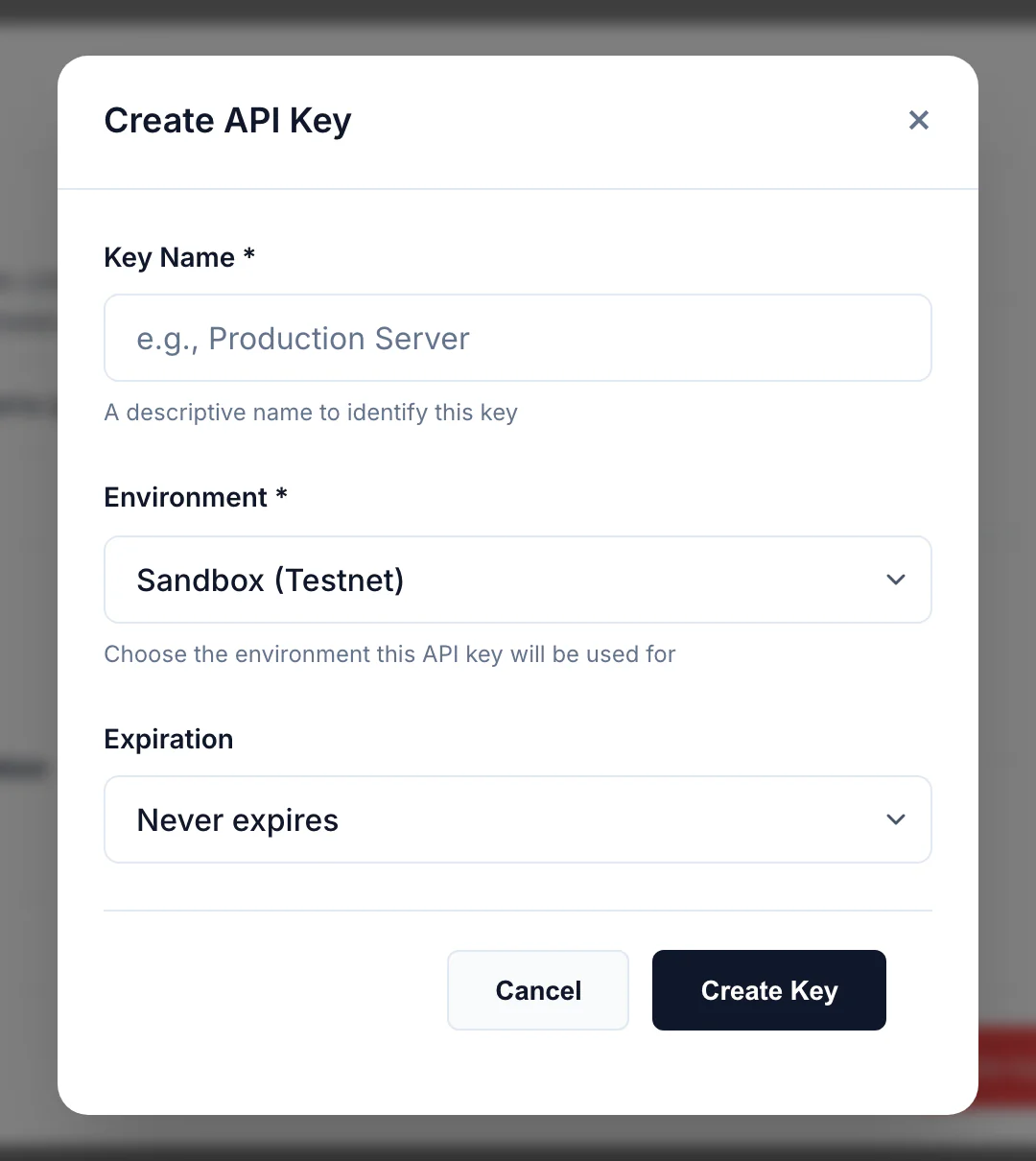
the loop. Each key is born with an environment, an optional expiry, and a
permissions column; each application gets its own encrypted Ethereum wallet
(AES-256-GCM under a master-key envelope) provisioned at creation.
Rate limiting rides the same identity: per-endpoint limits keyed by credential —
except auth routes, which are always keyed by IP, because brute force is an IP
problem, not a key problem. The middleware pipeline is the request's whole life:
CORS, rate limit, log, auth, handler, with a
req_ ID minted
for every request.
Honest notes: per-key permissions
are stored but not yet enforced — enforcement lives in the access-control system's
resource grants, and the two models coexist (deep-dive 7). And application keys are
stored plaintext in the database today; the refresh tokens got the hashing treatment
first.
One application, two keys — the environment is readable in the credential itself.Every request walks the same five stages and picks up its artifacts; 429 and 401 exit early with structured errors.
6 · Watching your own API — logging as a product feature
A decade of platform work teaches one social fact: developers don't file support
tickets, they file "your API is broken" — and the logs are how you (and they) find
out whose code it actually was.
Every request is logged asynchronously to Postgres — method, path, status,
duration_ms, IP,
user agent, and the application and environment resolved from the key — and
surfaced in the dashboard with 7-day stats (success rate, average latency,
errors-24h) and filters by app, environment, status class, and method.
Retention is policy-in-code: 7 days, enforced by a cleanup job every six hours, and
the dashboard says so in plain words — "Logs are retained for 7 days" — instead of
letting developers discover the horizon by falling off it. Pagination defaults to
50 rows, caps at 100; the logger skips
/health so
uptime probes don't drown the signal.
The deliberate omission: request and response bodies are captured as null — the
columns exist, and the code writes null into them on purpose. Privacy and payload
discipline over debugging convenience.
The log viewer live — stats, then a 4xx filter, then a path filter. Real traffic, real latencies.Async logging, a 7-day window enforced every 6 hours — and bodies written null on purpose.
7 · Access control — the big one, designed vs. shipped
The design prompt, paraphrased from the original brief: businesses are accounts on
whitelabeled developer infrastructure; roles are arbitrary groupings of permissions;
every resource carries read/write scopes; and — the differentiator — users span
multiple businesses, so a contractor or auditor is one identity with explicit
grants everywhere, not five silo accounts.
What shipped, in four commits over two days (~5,000 lines): a system I called
RCAC — resource-centric access control. Resources are
autonomous, owned by no business. Every access is an explicit row in
resource_access —
granted to a user or to a role, never both — on a
read < write < admin
ladder, optionally environment-scoped. Five system roles (OWNER through VIEWER) seed
every business, plus arbitrary custom roles. Business creation bootstraps the admin. An
audit log records every permission change. A business switcher sits in the dashboard
nav, and cross-business grants work at the API.
One identity, two businesses, explicit grants — resources belong to no one, access is always a row, and the old model still coexists.
Of the original prompt, the ledger reads: users spanning multiple businesses — shipped,
in the schema and at the API. Roles as arbitrary permission groupings — shipped.
Read/write scopes on every resource — shipped. Admin bootstrap, audit trail,
cross-business grants — shipped. What didn't: the legacy account model was never fully
migrated, so two auth systems coexist at HEAD and some legacy routes still assume the
old model; the "edit member roles" modal never shipped; and RCAC refresh tokens were
generated but never stored — a TODO that outlived the project, closed only while
preparing this page (the token deep-dive, next, describes the finished state).
The senior-engineer takeaway isn't the feature list. It's that access control is the
one feature you cannot bolt on — it forces the account-model rewrite, the migration
service, the dual-auth period, all of it — and this repo is a preserved specimen of
exactly what "halfway through the auth migration" looks like. That's worth showing,
because it's what most real systems look like on any given Tuesday.
8 · Tokens that expire in 15 minutes — and developers who never notice
Short-lived tokens are the cheapest way to shrink blast radius, and the fastest way to
infuriate a customer: naive 15-minute expiry means every developer's session dies
mid-work, and security that punishes the customer gets disabled. Both halves had to
ship together.
The server half is one hardening pass that reads like a checklist of things prototypes
skip: access tokens cut to 15 minutes; refresh tokens rotated on every use —
single-use, by construction — and stored only as HMAC-SHA256 hashes, so a leaked
database row is just a hash; BCrypt passwords; login rate-limited to 5 attempts a
minute by IP; account lockout; AES-256-GCM envelope encryption for wallet keys. The
RCAC user flow now runs the same pattern end to end — persisted, hashed, rotating
refresh tokens with the same 15-minute TTL.
The client half is TokenManager.js,
a small vanilla-JS layer that owns the token lifecycle so page code never sees it. It
schedules refresh before expiry, retries a 401 exactly once after refreshing,
and queues concurrent requests behind a single in-flight refresh — the subtle bug,
because rotation makes the second simultaneous refresh a hard failure. When refresh is
truly dead, it logs out cleanly instead of stranding the page. The result: the security
posture of a bank, felt by the developer as nothing at all.
15-minute tokens a developer never notices — refresh fires before expiry, rotation makes every refresh token single-use, and parallel calls share one refresh.
One aside the git log insists on: before any of this could matter, the first week was
~21 commits of fighting Docker, Railway, and
DATABASE_URL formats
before the API served its first request. The platform builder experiencing exactly the
onboarding friction platforms exist to remove — which is as good a mission statement as
any.
Selected screens
Key creation — environment and expiry chosen at birthQuickstart — account to first request in three steps
The reference index — humans up top, machine-readable links right under